
In a previous post I shared my practice of framing a school year through a theme derived from the First People’s Principles of Learning (FPPL). The first I’d like to explain in more detail the theme from 2022-2023, “Qui suis-je?/Who am I?” I’ve come to realize that the idea of supporting students towards their own self-actualization is foundational to all other themes and to our role as educators. This post will share my inspiration for the theme followed by how I implemented it in the classroom summed up with a generalized process I take with all themes and final thoughts.
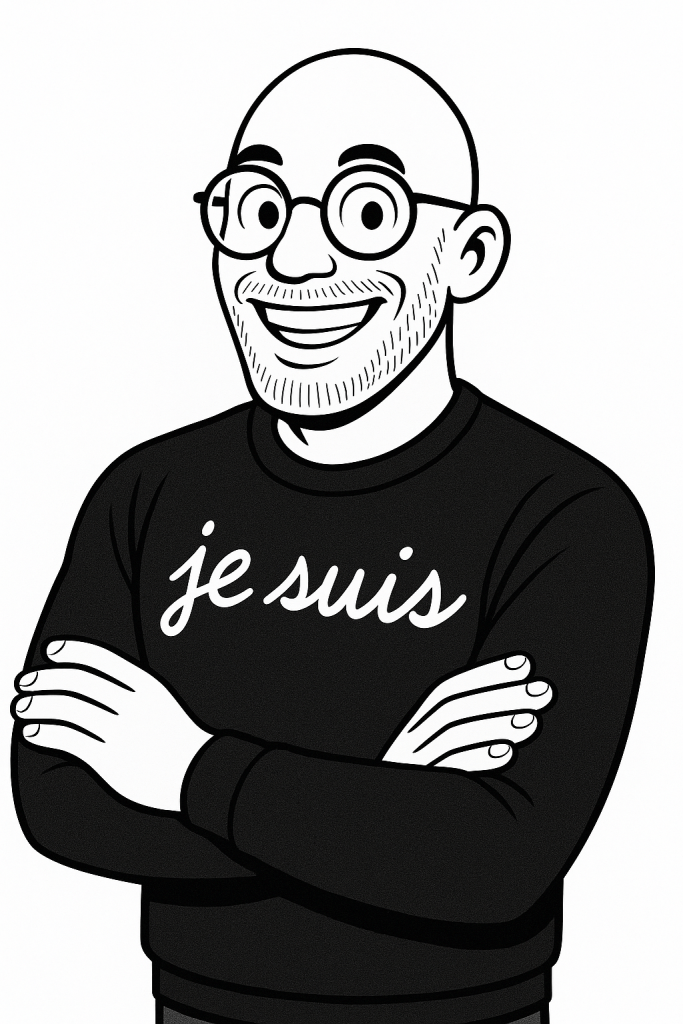
The FPPL from which this theme was derived is, “Learning requires exploration of one’s identity.” I was highly influenced at that time by Katz & Lamoureux’s Ensouling Our Schools: A Universally Designed Framework for Mental Health, Well-Being, and Reconciliation (2018). This book has offered ideas and activities that have become a pillar in my educational practice. As the title suggests, it presents a framework for teaching that is adaptable and flexible and highly aligns with my personal values and experiences. It begins with the idea of exploring spirit and soul in education:
Spiritual education, whether taught through religion or in a secular context, is recognized as having multiple pathways to the same goal- that living a life of meaning and purpose can be supported through secular and/or religious values. An ensouled school recognizes the needs of all human beings for connection, appreciation, respect, and meaning (p. 13).
The focus on values and holistic teaching of heart, mind, body, and spirit highly aligns with my beliefs and upbringing in the United Church of Canada as well as what drew me most to Kodály-inspired music education, notably his idea that
The characteristics of a good musician can be summarized as follows:
1. A well-trained ear.
2. A well-trained intelligence.
3. A well-trained heart.
4. A well-trained hand.
All four must develop together, in constant equilibrium. As soon as one lags behind or rushes ahead, there is something wrong (Kodály in Bónis, 1964, p. 197).
A central idea from Ensouling Our Schools that shifted my worldview and prompted the investigation of Who am I? was that of self-actualization. Katz & Lamoureux compare well-being and self-actualization through the Western perspective and First Nations perspective. In Western perspective, self-actualization is situated at top of Abraham Maslow’s hierarchy of needs compared to that of First Nations Perspective where self-actualization is the foundation of human needs (p. 23). This shift was transformational. The “self” as a foundation to a good society is not to be understood as selfishness, cut-throat, pull-yourself-up-from-your-own-bootstraps, ego-driven competition to “the top” as in the ca pitalist/colonial worldview but where “interdependence, rather than independence, is valued” (p. 24). These ideas parallel my more reading of The Courage to Be Disliked (2019) that explains Alfred Adler’s ideas on individual psychology (Kishimi & Koga, p. 158) and the goal of community feeling (p. 161).
The idea of independence leading to interdependence remind me of the words a university music professor, wind ensemble conductor Gerald (Gerry) King who would often say, “We are independent musicians workin interdependently” often as a reinforcement that we are individually responsible for our part of the ensemble and that we have to listen to one another to see how we fit into the whole of the musical piece. Another personal connection from the year I explored self-actualization with my students is my early journey with bodybuilding. My coach, Matt Law, would describe the journey as “working towards the best version of myself.” I took these words beyond the physical to the inner journey that is required. What would the best version of myself do? Would I cheat on my diet or workout half-heartedly? Or, would I put it my full effort and commit to my decisions? Even if I was tired and exhausted, would the best version of myself be unkind to others? In my first competition that year I came in seventh of eight competitors. How should the best version of myself respond? Should I give up or persevere with my physical goals? (Spoiler: I was very upset but I’m still going!) What is the best version of myself inside and out?
As I was asking myself these questions I was also guiding students through some activities and experiences as well as asking them the same question, “What would the best version of yourself do or say?” – the answer to which I can only answer for myself: be kind and respectful towards myself and others.
We began the year as I always do with a collage of our interests that becomes the cover to our binder as well as a metaphor for researching (more on this in another post). We then moved to what Katz & Lamoureux suggest with an exploration of our own gifts through completing a version of Howard Gardner’s Multiple Intelligences survey. We represented our results through written responses that allowed us to agree or disagree with the results and to reflect on how we can begin to share our gifts with others in the class. We then worked on a collaborative art project of a brain, which led to the question “Am I my brain?” whereby we explored the anatomy of the brain and mindfulness using Gravel’s Ollie: Un livre sur la plein conscience (2021) as well as activities from Afzal’s La pleine conscience pour les enfants (2019). From our collective inquiry on the brain, students then explored other body systems independently and then came to gather to see how they worked together interdependently. To conclude, they were invited to answer the question “am I my body?”
Fortuitously, the author Jeff Chiba Stearns visited our school that year to talk about his book On Being Yukiko (2021) and he shared his writing and drawing process which he called doing “Mesearch,” which I translated to “moicherche.” After Winter break, we dove deeper into our identity exploring the question “how am I Canadian?” reading not only Yukiko’s story but also that of Gladys (BC Teachers’ Federation, 2017) to learn how the story of one person or character can often represent a greater human experience. The capstone project was an independant “moicherche” to our own heritage and culture in relation to Canadian history aligned with the BC Curriculum for Grade 5 and 6 Social Studies.
It may be clear to the reader that a big part of my planning for the year comes from inviting my students to join me in my own journey towards self-actualization. I recycle routines, structures and activities for subjects but look at them through the lens of the theme and adapt them accordingly. The year unfolds and activities and experiences often present themself as both the students and I learn.
What I have come to learn about myself through 2022-2023 “mesearch” is that I have a gift of synthesis and connection and that I am flexible enough to pivot my ideas to respond to what is happening in society, in our school, and in our class. Through learning through this theme alongside students I continued my personal journey to self-actualization. I believe it was an authentic way to live the First People’s Principles of Learning and work towards decolonizing my teaching practice by modeling humility and vulnerability to explore my own identity and work towards being a better version of myself.
Where do you see yourself in this story? I’d love to hear your thoughts in the comments
Are identity and education interdependent? Should they be or not be?
What does the best version of yourself as an educator look like, sound like, feel like?
Autios! À la prochaine!
Bibliography
Afzal, U. (2019). La pleine conscience pour les enfants: Aidez votre enfant à être serein et heureux du petit déjeuner au coucher. Traduit par Patricia Lavigne. La page. Paris.
BC Teachers’ Federation. (2017) Gladys we never knew: The life of child in a BC Indian residential school. https://www.bctf.ca/classroom-resources/details/gladys-we-never-knew Accessed May 14, 2025.
Chiba Stearns, J. & Blakey, L. (2021). On being Yukiko. Meditating Bunny Studios. Vancouver, BC.
Gravel, E. (2021). Ollie: Un livre sur la pleine conscience. Scholastic.
Katz, J. & Lamoureux, K. (2018). Ensouling our schools: A universally designed framework for mental health, well-being, and reconciliation. Portage & Main. Winnipeg, MB.
Kishimi, I. & Koga, K. (2019). The courage to be disliked: The Japanese phenomenon that shows you how to change you life and achieve real happiness. Simon & Schuster, Toronto, ON.
Kodály, Z. (1964). The selected writings of Zoltán Kodály. Ed. Ferenc Bónis, translated by Lily Halápy & Fred Macnicol. Boosey & Hawkes, London.
OpenAI. (2025). [Monsieur Autio Wearing Custom ‘je suis’ Sweater] [AI-generated image]. ChatGPT. https://chat.openai.com/

 Monsieur Autio
Leave a comment