
Bonjour! I’m Monsieur Jake Autio and welcome to Autio Clips. Over the years, I’ve learned that to become a great teacher, I must become the best version of myself — because who we are is how we teach. Each episode, I aim to explore education through the lenses of inspiration, intention, and integrity, and I hope you’ll see yourself in these stories and conversations. On y va!
Why a podcast?
Over the past six weeks, I’ve been completing coursework toward a certificate in Teacher-Librarianship at the University of British Columbia, which gave birth to this blog! Little did I anticipate enjoying the process so much that a whole Monsieur Autio brand, including a recurring AI-generated image, would emerge.
The main themes we explored in our course encompassed equity, ethical and meaningful use of technology in the library learning commons space, as well as the role of the teacher-librarian in professional development. As a capstone project, we were asked to create a digital artifact that summarized our learning and pushed us to use technology in a new-to-us and meaningful way. I initially thought I’d try my hand at making Reels for Instagram to showcase my own inquiry cycle, but as I researched the process, I felt uninspired and unable to go deep into the content I wanted to create.
Then I thought about the complimentary feedback I had received from my classmates, colleagues, and my instructor about my reflective narrative writing in my blog. It made me think that a podcast would be a way for me to tell my stories in my own voice. Right away, that idea seemed to “fit” better—as a lover of audiobooks and podcasts. Moreover, since my blog has a theme of identity rooted in inspiration, intention, and integrity, what better way to share my ideas and reflections than with my actual voice?
The purpose of the podcast is therefore to bring this blog to life and to practice Puentedura’s SAMR (Substitution, Augmentation, Modification, Redefinition) model (PowerSchool, 2025), particularly the idea of Modification by adding a new form of engagement, and eventually Redefinition through the addition of interviews and dialogue.
The Process in the Process:
The learning process within a learning process was underway. I already had my initial content for the podcast within my blog inquiry process posts (Learning is… and Inquiry Part 1 and Part 2), as well as in course discussion threads. We are now at the final stage of inquiry: réaliser (creating) and partager (sharing).
My main task was to go through the process of learning how to create a podcast in order to share my learning. I consulted friends who had podcasts, as well as my partner, who had a short podcast as well (which meant we had some equipment in the closet!), and I watched a few YouTube tutorials.
My friend Alex recommended Audacity as free audio editing software, though on iPad it didn’t seem to be free. Since I wanted to be thrifty, I went the route of GarageBand and told myself that it was also good for me to learn—as we are an Apple school district—and that learning GarageBand is a useful skill I could introduce to my students.
Three main YouTube tutorials proved most useful for my project.
Think Media’s “How to Start a Podcast in 2025” (December 16, 2024) provided an easy step-by-step guide (see YouTube link):
Step 1: Define Your Topic and Niche
– Choose a specific topic and niche. The more focused, the easier it is to attract a loyal audience.
Step 2: Choose a Podcast Name and Distribution Plan
– Pick a name that is relevant, memorable, and searchable.
– Add a catchy tagline or phrase.
– Design some simple but eye-catching artwork.
– Choose your distribution platform(s) (e.g. Spotify, Apple Podcasts, YouTube, etc.).
Step 3: Set Up Your Tech and Format
– Decide on your podcast format: solo, interview-based, narrative, etc.
– Video podcasts are on the rise — 33% of U.S. listeners prefer watchable podcasts.
– Invest in a good microphone and camera (a smartphone can work to start).
– Ensure you have decent lighting and soundproofing if possible.
Step 4: Record Multiple Episodes
– After your tech is set up, record your first few episodes.
– Launch with at least three episodes to build early momentum. You can release all at once or one per week.
– Keep episodes short and engaging at the start.
– Don’t stress — consider this a learning phase.
Step 5: Edit Your Episodes
– Keep editing simple and clean — podcasts should sound conversational and natural.
– Add an engaging 10–30 second hook at the beginning (could be a highlight or teaser).
– Trim out big mistakes or awkward pauses, but avoid over-editing.
Step 6: Publish and Promote
– Create a clear, clickable title for each episode.
– Publish to your selected platforms.
– Promote using short clips on social media (Reels, TikTok, YouTube Shorts)
– Being a guest on other podcasts to cross-promote
– Using your existing networks and email lists
Step 7: Review and Improve
– Reflect after each upload: What went well? What didn’t?
– Any technical adjustments needed (mic, camera, editing)?
– Review your analytics and read/listen to feedback. Use insights to improve future episodes.
My Process:
Step 1: Define Your Topic and Niche
For me, I already had a topic and niche in mind—reflections on teaching for reflective teachers. In other words, I imagined you, my reading audience and other teachers, listening to my podcast on your way to work, while folding laundry, going for a walk, or on a treadmill—just like I do with my favorite podcasts and audiobooks. I hope it gives you a reflective moment and some inspiration.
My podcast and blog are letters from a reflective teacher to reflective teachers. I plan to keep writing and podcasting in the coming months and years, linking them together, and hearing how we can grow—professionally and personally—together.
Step 2: Choose a Podcast Name and Distribution Plan
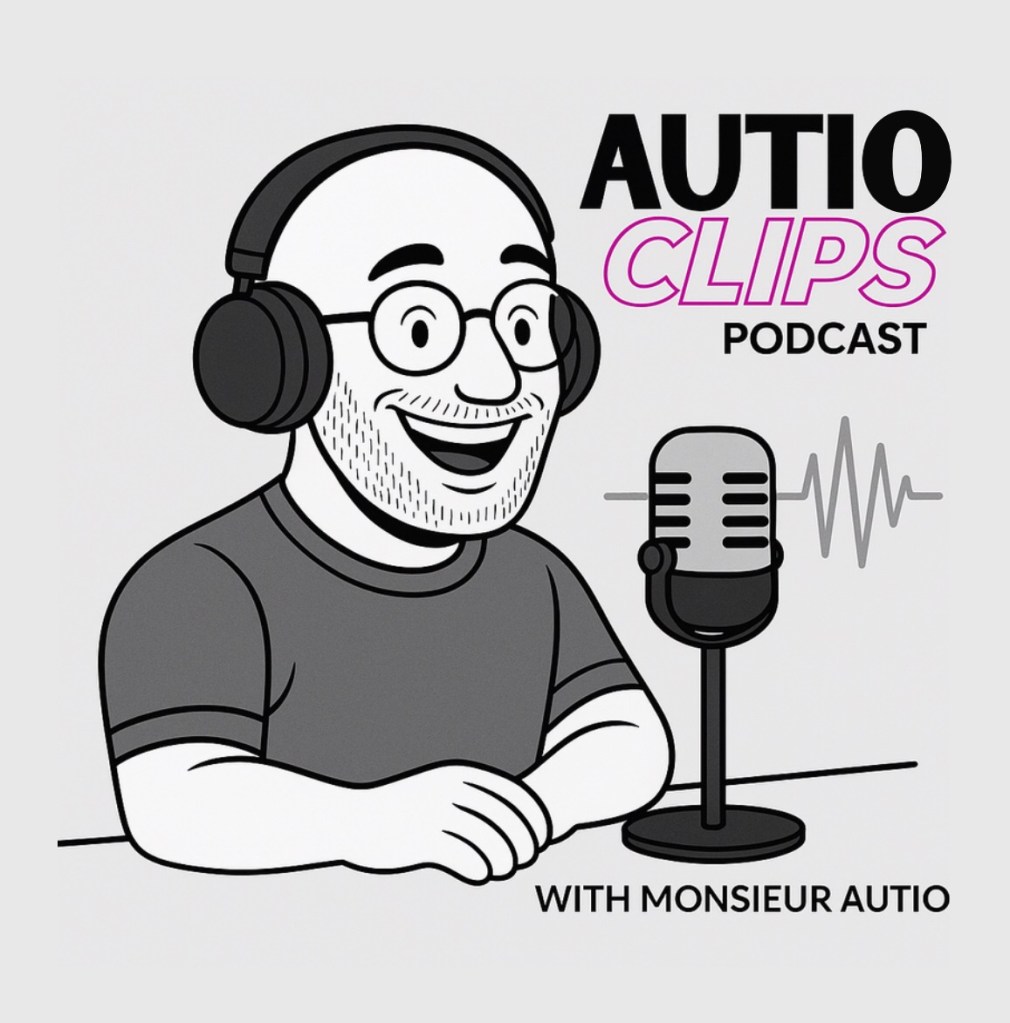
As for the name, I leaned into how my last name closely relates to the word “audio” and the fact I wanted to create shorter podcasts (shortcasts). The pun Autio Clips was a natural choice—at school, my read-alouds are already called “Autio books” (as you’ll hear in the podcast). Since I had already established a bit of a brand on the blog, the OpenAI-generated image of me as a podcaster was an easy design. My existing blog branding lent itself to taglines and themes influenced by Katz & Lamoureux (2018), Kishimi & Koga (2019), and Palmer (1998).
For distribution, I learned about RSS feeds through two YouTube tutorials (DylanTalksTone, 2018; Think Media, 2024) and went with Spotify’s RSS since it was free.
Step 3: Set Up Your Tech and Format
My format was inspired by Oprah’s Super Soul Conversations and Amy Poehler’s The Good Hang. Oprah brings depth; Amy, levity—a lofty goal for an assignment! I also consulted ChatGPT for outline ideas, but aside from timing suggestions and the idea to include “clips,” I didn’t end up using much of the content.
Luckily, my husband, Mr. Tong, had a microphone tucked away. A couple of podcasting friends recommended Audacity, but it didn’t seem free on iPad. I went with GarageBand instead—the next freest option I knew. Flynn’s (2018) tutorial came in handy… until it didn’t.
Step 4: Record Multiple Episodes
I often tell my students “Fait le mieux que tu peux avec le temps que tu as” (“Do the best you can with the time you have”), and at this juncture, I had to take my own advice. With the deadline looming, my goal of three episodes—including an introduction, a curated interview with Mr. Tong, and a course recap—was reduced. The learning curve of audio engineering took longer than anticipated.
Though Mr. Tong and I spent hours recording (the best take, of course, didn’t record properly!), I lacked the skills to cut and splice our conversation into a cohesive narrative. The morning after, he asked, “How does it feel to be a student?” I admitted it was frustrating to take direction while learning something new. That said, it led me to record a solo episode with more confidence. I also created my opening melody in GarageBand and applied what I learned from Flynn’s video.
In the end, I finished two episodes—enough to meet the assignment criteria—and have raw audio for a future episode. I didn’t quite meet my initial goal, but I learned a lot in the process.
Step 5: Edit Your Episodes
Though I have two music degrees, I often joke that if an instrument needs electricity or strings, it’s not my forte. Brass, woodwinds, and voice—or a baton—are more my style. So I’m not quite an Autio engineer yet! The challenge: I can hear when audio isn’t quite right. I felt the creative frustration of the product not matching the Oprah/Amy vision in my head.
Mr. Tong gave me honest feedback—my first episode “didn’t sound like myself.” It was too professional, too hesitant. I felt the pressure of the deadline and the tech learning curve—but also the push to grow.
Step 6: Publish and Promote
Through Spotify and this blog, I published and promoted my very first podcast! What do you think? Comment and subscribe! (Maybe I need a fourth “in” to my list: inspiration, intention, integrity, influence.)
Step 7: Review and Improve
With my critical ear, I heard background hissing in Clip 1, which I tried to troubleshoot through further tutorials. In Clip 2, I took Mr. Tong’s feedback to heart and just tried to talk like I was on the phone with a friend. I forgot to end Clip 2 with my signature “Autios! À la prochaine!”—and there are still some rough spots. But the tutorials reminded me: it’s not about perfection the first time.
I sent Clip 1 to my friend and fellow podcaster Alex, a personal trainer. He said:
Dude that was awesome… you really created an identity with the listener right away… The production and little quirks you did were awesome too… You sound super genuine… I can see how you are with your students and I instantly got transported to one of your classrooms.
There were a few cuts that were a bit abrupt… maybe smooth the transitions. Your intro could use a bit of instrumental to distinguish it. And honestly, I wanted it to keep going—it was such a cliffhanger!
This was my first listener comment and a valuable reminder for future episodes.
Closing Thought
Hopefully this was some help to you, and I hope that it gives you an opportunity to understand how powerful your voice can be. No matter who you are, no matter where you are, no matter how basic your equipment is, we can have a voice and share it with the world. This is a really important concept: if we have a voice, and we have something we want to share with the world, we can do it. (DylanTalksTone, April 25, 2018)
This quote reminded me of the same speech I give my students before they sing: our voice is our gift. Together, our voices are stronger—and can change the world. It was a much needed reminder as I went through the creative process myself.
In Clip 2, I share how my professional journey continues to evolve through lifelong learning. I feel affirmed by the course themes of equity, critical thinking, leadership, and reflection; challenged by new tools like blogging and podcasting; and excited for what’s to come—in person, and virtually.
On y va! (Let’s go!)
Where do you see yourself in my story?
When have you recently felt the pinch of a deadline that led to a creative breakthrough?
What’s a skill you were once reluctant to try but are now glad you did?
Autios! À la prochaine!
Bibliography
Canadian School Libraries. (2023). Foundations for school library learning commons in Canada: A framework for success. Retrieved May 14, 2025, from https://www.canadianschoollibraries.ca/wp-content/uploads/2023/11/CSL_Foundations-Frameworks_FINAL_Nov2023.pdf
DylanTalksTone. (2018, April 25). How to start a podcast for free with GarageBand and Anchor [Video]. YouTube. https://youtu.be/R7Yz1‑BIGlM?si=P0fEQPVCfqsa5E1‑
Katz, J. & Lamoureux, K. (2018). Ensouling our schools: A universally designed framework for mental health, well-being, and reconciliation. Portage & Main. Winnipeg, MB.
Kishimi, I. & Kona, F. (2019). The courage to be disliked: the Japanese phenomenon that shows you how to change your life and achieve real happiness. Translated by Kirawareru Yuri. Simon & Schuster Canada, Toronto, ON.
OpenAI. (2025). Autio Clips podcast script outline and episode guide [AI-generated content]. ChatGPT. https://chat.openai.com/
OpenAI. (2025). Monsieur Autio asset image for podcast Autio Clips [AI-generated image]. ChatGPT. https://chat.openai.com/
Palmer, P. (1998). The courage to teach: exploring the inner landscape of a teacher’s life. Ed. 1. Jossey-bass. San Francisco, CA.
PowerSchool. (2025). SAMR model: A practical guide for K–12 classroom technology integration. PowerSchool. https://www.powerschool.com/blog/samr-model-a-practical-guide-for-k-12-classroom-technology-integration/
Think Media. (2024, December 16). How to start a podcast in 2025 (start to finish) [Video]. YouTube. https://youtu.be/8UYbUsfbBW0
Flynn, P. (2018, February 16). How to record & edit a podcast in GarageBand (complete tutorial). [Video]. YouTube. https://www.youtube.com/watch?v=xhesskgmIsQ


 Monsieur Autio
Leave a comment