
“It’s time to share your gift with the audience.”
Before students go on stage I try to reassure them that they are about to share a gift of hard work to the audience, their family and friends. Then the French Café playlist fades and the actors walk out into the school outdoor courtyard, now transformed into a theater. This annual soirée has become more than a showcase of drama, choir, band, and visual arts. It’s an invitation to witness the learning, creativity, and courage of students in Division 15, Monsieur Autio’s class.
A Memory Reimagined
The idea for Café 15 comes from vivid memories I carry from when I was in grade 5 and high school jazz band. In Grade 5, I remember transforming our school multipurpose room into a spot-lit corner stage and gallery for parents. We shared our student-made speeches and poems and displayed our art at the side of the room. The magic of this evening performance stayed with me. And, believe it or not, I was a band nerd in high school and a regular spring fundraiser was our Cafe Jazz complete with cake and bands sharing their music from the year. Now some twenty years later, I’m teaching Grade 5/6 French Immersion and I hope to share these experiences with my students and make them a rich learning experience connected to curriculum.
From Reader’s Theater to Performance
Before it was “Café 15” three years ago I had students do a significant drama unit where I had students work towards memorizing and presenting simple plays. The first year I found some plays online but many of them proved too difficult or convoluted. In my second year I found out our school had the collection of French Readers Theater from Chenelière Éducation. They proved to be ideal for immersion learners and by having students memorize them we were able to dive deep into pronunciation, expression, grammar, and comprehension. There are also enough for me to cycle through them and each have many opportunities for students to make them their own!
We begin typically preparations after Spring Break and perform late May or early June. Students first read through 5–6 choices of plays (excluding last year’s repeats) then student rank their top three. I puzzle together casts based on numbers and parts. Everyone gets typically one of their top picks, not necessarily the part, but the play.
Once groups are announced, students read, choose roles collaboratively, and hear the classic reminder: “There are no small parts — only small actors” and I remind them that regardless of the length of their part there is a lot of responsibility for each actor to bring the play to life.
Madame Kibbkewhite, my incredible student teacher this year, introduced a theater vocabulary early on in the process this year— parts of the stage, names of theater professionals — and this helped our young actors communicate with better precision for the overall project. Certainly a value-added addition!
The Work Behind the Scenes
From comprehension to performance, students are deeply involved. They analyze characters and plot using graphic organizers that inform them to write summaries. This is done in hopes to help them to connect the play’s moral to our yearly theme and I can use it as a way to assess their comprehension. This ultimately helps them create storyboards (another brilliant addition from Madame Kibblewhite) which evolve into set designs using the design process.
To aid initial comprehension and memorization, students read (and reread, and reread, and reread) their scripts during silent reading. Some copy out their lines, others listen to voice recordings of their lines, some lip-sync. I teach them strategies like looking and reading it then closing their eyes to say it again, reading it to themselves in the mirror in the bathroom at home, and starting from the end and moving to the beginning.
I meet with each student individually for pronunciation, liaisons, and expression coaching cycling through the class a couple few times. As a result, reading becomes more accurate and fluid and I can help them find more of the humour and nuance in their individual parts. From this we begin table reads with groups.
During table reads, I typically can listen to a group and give tips for expression and make sure they understand how their part fits into the whole. I cycle through each group and after a couple rounds I invite them to start thinking of blocking and the full embodiment of the play. During initial rehearsals we go over turning our body to the audience, “over acting” our gestures and expressions, and notes for transitions and potential sets and props they may need to make or find.
We then start to rehearse in rotating trios: one group performs, one gives feedback and records the performing groups one watches recordings from their last performance and compares their written feedback to what they see on video and then do their best to improve. This year Madame Kibblewhite refined the peer feedback structure with a three point focus on gestures, volume, and clarity. Next year, I plan to collate these into feedback booklets so students can better track their growth over time.
Inquiry Comes Alive
This year, Madame Kibblewhite expanded the preparation process with deeper inquiry about the setting. This year, one play was set in the Guatemalan jungle with animal characters which led to research about the actual animals and ecology of Guatemala. Another, a retelling of The Odyssey, launched an exploration of Greek mythology. Students studying The Sword in the Stone dove into medieval life and King Arthur legends. Their understanding deepened, and their imaginations took off. We had them generate lots of questions based on what they noticed and knew from their plays to research and many continued the research well towards the end of the event!
Designing the Stage
As set design begins, our classroom becomes creative chaos, cardboard, paint, hot glue, and overflowing costume bins. Students sketch, build, try things on, and make decisions as a group and collaborate to make and curate the sets and costumes. We measure the stage (a garden bed in our courtyard that revealed itself during the outdoor days of early COVID) and recreate its dimensions in chalk on the blacktop for practice and rehearsals increasingly include props and sets.

Q2Q and How to Bow
With a week or so to go, we focus on transitions, learning to enter and exit quietly, to bring props on and on, to be ready to transition from group to group. We run “Q2Q” style mini-rehearsals and teach one of the most underrated skills of performance: how to bow.
“Hello, shoes! Up!”
That’s what I say to help students learn a unified bow: hands on lap, slide down to knees, eyes on their shoes, up together. I wish I remembered who taught me that in university. Thank you, whoever you are. I use it every year. I often tell them “I went to university for $20,000 to learn to bow. You get this lesson for free!”
Minute By Minute Plan and Roles for Everyone
I have now made a minute-by minute overview of the evening that I go through with students. We then walk through it and I print copies for the green room (paper storage room). We also decide our hosting duties: greeters, ushers, servers for all the food and beverages and bus people (“pillow fluffers” who clean up and take used plates from guests). Before any guest arrives everyone knows where to go and what to do.
Dress Rehearsals
The day before and/or on the evening event we invite our peers to come and watch our dress rehearsals. Sometimes the audience reaches upwards to 150 kids! Our MCs and “entr’actes” get a chance to practice and each group does two run throughs whereby teachers offer feedback in between for immediate application. After all dress rehearsals we have one last sit down to make sure everyone knows where to go and what to do.
Showtime!
As a result of all this preparation the evening unfolds with confidence and joy. As families arrive, they’re greeted by ushers and given student-creates programs (yet another value added idea from Madame Kibblewhite with headshots, bios, and cast lists in addition to the choir and band programs) and make their way through to the courtyard.
French café music sets the tone as the audience finds their seats. Backstage we huddle and I give some words of encouragement:
“You are giving your gift. You’ve worked hard. Whatever happens tonight, be proud and share your hard work with the audience.”
Right on cue, MCs welcome the audience. Students, quiet in the wings (well… mostly) and wait for their moment. Backstage they are buzzing waiting their turn. They perform, they transition, they give their gifts.
After the plays, I take the stage while students line up for choir. Students enter, we sing songs from throughout the year — our song for the Remembrance Day assembly, songs from other school concerts and productions, and many canons and folk songs we’ve sung from September to the show. After our final bow for choir, we transition from stage to gym, where families mingle at our either our art gallery (2004- Artivism) or our band performance with the band teacher (2025).
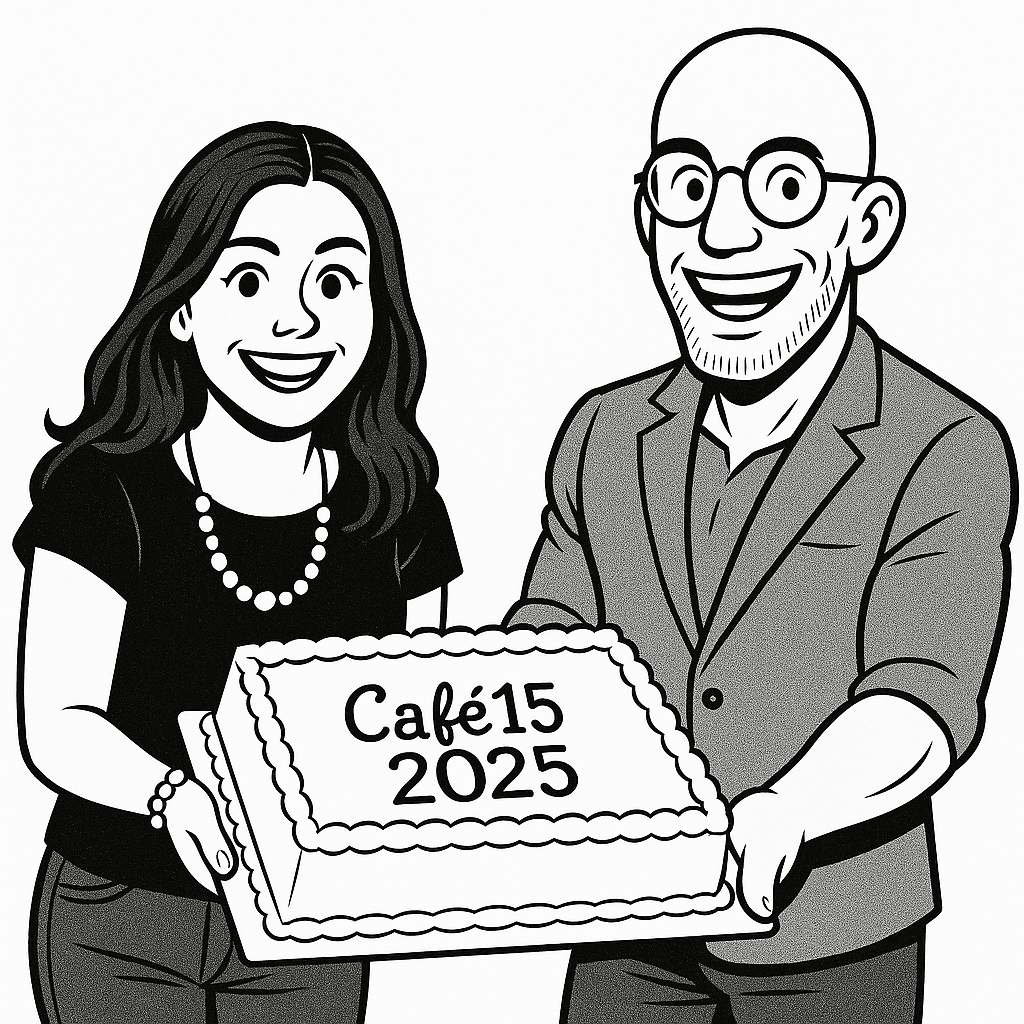
Then, the piece de resistance, we serve our families cake, whipped cream, ice cream and berries, graciously prepared and coordinated by Mr. Tong and, since 2024, my mom, dad, and other friends. Then families and friends leave, delighted to have received the gifts their children gave them.
Every Year Something New
Each Café 15 evolves. The first year, 2023, was plays and choir followed by the reception. That year, Mr. Tong made custom buttons based on the student-made logo as a momento; in 2024 we introduced the activism through art gallery “artivism,” had an alumni choir join us for the final choir piece and Mr. Tong made more buttons with the new logo. This year, 2025 our band teacher joined us, and students performed two band pieces while Mr. Tong one upped himself and made personalized keychains with every child’s name on it and the current logo.
Madame Kibblewhite added rich details to the evening: Headshots taken during set design welcomed families at the entrance and their bios derived from journal entries became personalized program inserts. Not only that, she added a showcase of each step of our learning on boards to show the process from selection to showtime. Even her family and friends came out to support and help out! To top it all off, she handmade each child a silk rose as a parting gift tying to a journal prompt she had kids write a few days before.
Logistics
We charge a small fee, usually $4–7, to cover food. With about 100 – 150 attendees it balances out with some leftovers for a cast party a few days later in class, yet another Madame Kibblewhite addition. The event keeps growing — and with it, so does the pride in our shared learning and the legacy of Division 15.
In 2023, I even had students create the budget along with me using it as an opportunity to build some numeracy skills! I use the same budget now each year and update the costs.
Beyond the Curriculum
Café 15 integrates:
• Literacy through scripts, summaries, expressive reading.
• Numeracy through budgeting and stage measurement.
• Art and ADST through set design and costume creation.
• Social Studies through cultural inquiry.
• Music through choir and band
• And likely even science, somehow.
But more than any subject, it teaches purpose, patience, responsibility, collaboration, presence, and hospitality (BC Core Competencies!). Students become performers and hosts and give back to their families.
Building a Legacy
Every year, students in younger grades ask:
“Do we get to do Café 15 when we’re in Division 15?”
The answer is maybe. It may shift one day for a multitude of reasons, in fact, next year I will no longer be Division 15 but Division 14 due to a shift in the school population. Therefore, with this we will have to respond and adapt. Perhaps it will not longer be a café but a soirée or a salon? Maybe a future class needs something different all together.
For now, it is everything I dreamed as a teacher: real life learning in action, literacy coming to life! Café 15 is a celebration of learning, community, and the beautiful risk of performance. It’s a reflection and an avenue for me to share my own gifts of music, education, theater, event planning and a challenge for teacher candidates like Madame Kibblewhite to do the same. Overall, it is a showcase for the capabilities and many gifts students and teachers bring to the world and a true collaboration between everyone involved.
Where do you see yourself in my story? Comment below!
What’s a core memory for you that you gift to your students?
Would you take on something like Café 15?
Autios! À la prochaine!
 Monsieur Autio
Leave a comment