
This past year’s theme was courage, and it linked closely to the Aboriginal Ways of Knowing and Teaching: l’apprentissage est un parcours qui nécessite du courage, de la patience et de l’humilité (“Learning is a journey that requires courage, patience, and humility.”)

The inspiration for this theme was certainly my often-quoted books Kishimi & Koga’s books The Courage to Be Disliked (2018), The Courage to Be Happy (2019), and Parker Palmer’s The Courage to Teach (2007). Through exploring this theme, I began to better understand, practice, and test the theories in these books. With an additional resource from personal counsellor introduced me to: COAL strategy (Curious, Open, Accepting, Loving) I felt I was able to be a better version of myself for my students and hopefully they, too were able to self-actualize more as well.
The four main ideas and lessons I took from these books that I wanted to practice and share with my students were:
- Teleology: Events have no inherent meaning—you decide their meaning and therefore your own behaviour.
- Separation of Tasks: Much of our unhappiness comes from interfering in other people’s tasks, such as trying to control how others see us or expecting others to act a certain way. We are in charge of our own learning, no one can learn for us.
- Finding Freedom in Self-Acceptance: Once you fully accept yourself, you no longer need others’ approval. You can live your values instead of living to please or dominate others.
- Collectively Working Towards “Community Feeling”: A healthy lifestyle is oriented toward contribution, connection, and equality—not superiority or inferiority of others—“we are equal but not the same” (Kishimi & Koga, 2018, Courage to be Disliked, p. 74).
Collaborating with the School Counsellor
We began the year with some collaborative lessons with our school counsellor, Ms. Jayarajah. These lessons were both social-emotional learning and Core Competency-focused, and they extended the idea of courage to include dignity and respect, which align with the Adlerian idea of being equal but not the same.
The definitions Ms. J gave us were that dignity is given, respect is earned. We all are worthy, but we must act in the right way to gain respect from our peers. We examined how our behaviour and our reactions to problems are both choices. With Ms. J, we worked through scenarios about how our actions are perceived, how we can justify our opinions with respect, and how we can sort and establish our personal values. This led us to an activity where we explored who we are on the inside, represented by value words we put in an envelope, and how we present ourselves on the outside with words about our appearance and likes and dislikes.
I captured our learning in this chart:

After our series of lessons with Ms. J as well as our exploration of books that I’ll present below, we created a class contract that showed we feel emotions, but we are not our emotions. We continued to explore the idea of “inside out”—what we show versus what’s inside—which culminated with watching Inside Out 2 as part of our Halloween party. My student teacher, Madame Kibblewhite, even dressed up as Joy from the movie!
We sorted values and discussed living our values, and we built a class contract about our goals, tasks, needs, roles, and responsibilities. These all align with one of my core teaching values and goal for students of instilling independence: I often ask the class, “Who does your learning belong to?” They know the answer is “Myself!”
By the time we were done with these lessons around October, we were able to collaboratively create our class society standards that included everyone’s rules and needs (teachers included!) as well as students’ tasks and teachers’ tasks:
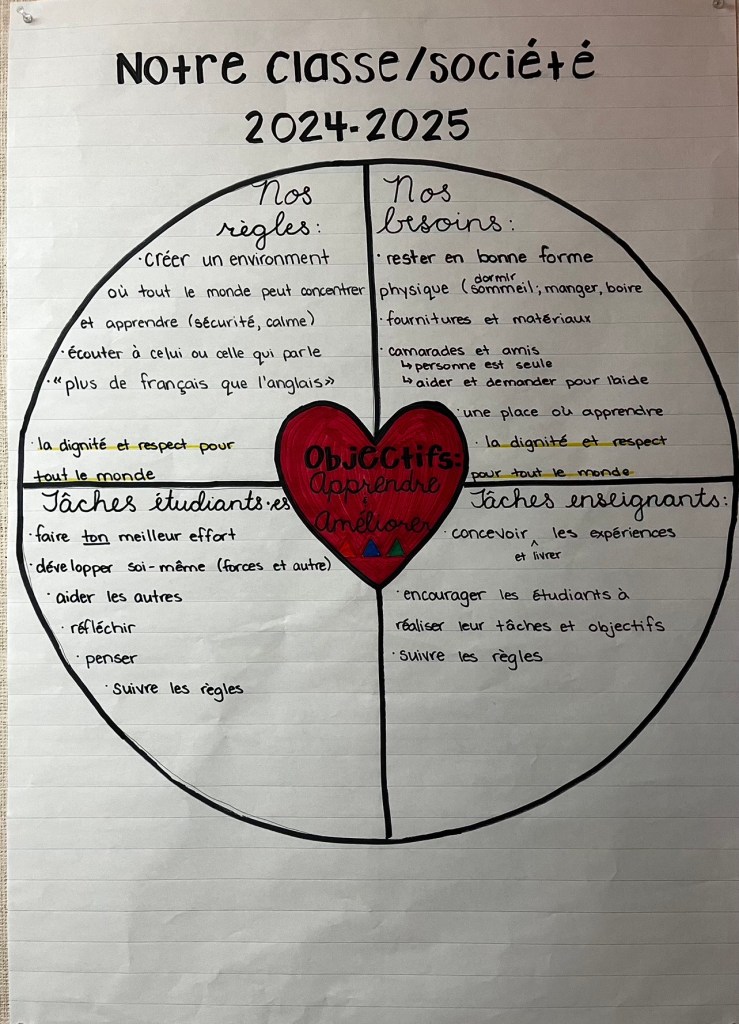
Here is what the poster said:
Objectif (Objective): [ie.why are we at school?]
– Apprendre & Améliorer (To learn and to improve)
Nos règles (Our Rules):
– Créer un environnement où tout le monde peut se concentrer et apprendre (sécurité, calme) (Create an environment where everyone can focus and learn – safety, calm)
– Écouter à celui ou celle qui parle (Listen to the person who is speaking)
– Parler plus de français que l’anglais (Speak more French than English)
– La dignité et le respect pour tout le monde (Dignity and respect for everyone)
Nos besoins (Our Needs):
– Rester en bonne forme physique (sommeil, manger, boire) (Stay in good physical health – sleep, eat, drink)
– Fournitures et matériaux (Supplies and materials)
– Camarades et amis (personne est seul, aider et demander pour l’aide) (Friends and classmates – no one is alone, help and ask for help)
– Une place où apprendre (A place to learn)
– La dignité et le respect pour tout le monde (Dignity and respect for everyone)
Tâches étudiants (Student Tasks):
– Faire ton meilleur effort (Do your best effort)
– Développer soi-même (forces et autre) (Develop yourself – strengths and more)
– Aider les autres (Help others)
– Réfléchir (Reflect)
– Penser (Think)
– Suivre les règles (Follow the rules)
Tâches enseignants (Teacher Tasks):
– Concevoir les expériences et fixer (Design and set up learning experiences)
– Encourager les étudiants à réaliser leurs tâches et objectifs (Encourage students to complete their tasks and goals)
– Suivre les règles (Follow the rules)
As you can see, there are many themes and core values put into our class society from the Courage books including the separation of tasks, the fact that we all have to follow the rules (we are equal but not the same) and that we all have collective needs and a shared space. It also shows clearly that my role as the teacher is not to learn for them but to provide them with learning experiences.
It helped me with classroom leadership as I could say “are we creating an environment where everyone can learn” or “what’s your task right now?” Later in the year, we added “what is your feather?” after our work with Coach Sand. With these prompts, students would then be reminded of the expected behaviour and hopefully instilled more intrinsic motivation rather than extrinsic manipulation and respect and dignity for all. No point systems needed!
This poster was beside the exterior door for the year. Once my student teacher Madame Kibblewhite came, she reviewed and added some clarifications as she was now a part of the society. This helped her establish her role as a teacher in the society as well.
Where Do We See Courage in This Story?
Aside from our SEL lessons with Ms. J., stories became an avenue for us to define and identify different aspects of courage. For our literacy focus in the fall, we practiced summarizing picture books both orally, modeled in class (copying from the board), in groups, and eventually in individual summaries. For each book, our conclusion was the answer to the question “Where do we see courage in this story?” This competency was reinforced several times throughout the year in science, socials, and then for their Café 15 plays, and it set us up for our final inquiry of the year.
We focused on vocabulary such as confidence, responsibility, humility, “bienveillance” (kindness/caring/goodwill), self-sacrifice, perseverance, bravery, determination, resilience, dignity, and hope. I made a word wall with these words and their definitions as well a a courage anchor chart that we added to as we read different stories. As a review of the stories, we matched the books to these words and then used the vocabulary to help us write meaningful conclusions moving forward. Later in the year, after Café 15, we even used these words to reflect on our personal experience showing courage to perform.
Books and Stories with Connections to Courage
Below you will find the books and stories we read this year and how they relate to the courage theme with a link to them for your convenience.
Ceux qui décident by Lisen Adbage (2019, L’Étagère du Bas)
This picture book explores collective decision-making and the courage to stand up for your right to dignity in a group setting.
Le vélo de Sergio by Maribeth Boelts & Enzo (2022, Éditions Scholastic)
Sergio dreams of having a bike of his own, demonstrating perseverance and courage to tell the truth and do the just thing.
Jabari plonge by Gaia Cornwall (2019, Éditions Scholastic)
Jabari bravely faces his fear of jumping off the diving board, capturing the courage of children confronting everyday anxieties.
Les mots volés by Melanie Florence & Gabrielle Grimard (2016, Éditions Scholastic)
This story shows the courage to preserve cultural identity and reclaim language in the face of erasure.
Neuro by François Gravel (2017, Québec Amérique)
Neuro explores themes of neurodivergence and oppressive social structures and the bravery required to cooperate and escape. (BONUS: this book starts with little to no ponctuation and an opportunity to discuss and analyze a unique text; connection to brain research and anatomy)
Rouge : L’histoire d’un crayon by Michael Hall (2019, Éditions Scholastic)
A mislabeled crayon finds the courage to be true to itself despite others’ expectations; once it embraces its identity, everyone else does too.
Les bas du pensionnat by Christy Jordan-Fenton & Margaret Pokiak-Fenton (2012, Éditions Scholastic)
This autobiographical story depicts a young Inuit girl’s resilience and courage as she navigates residential school while holding on to her identity.
Courage, petit lapin! by Nicola Kinnear (2018, Deux Coqs d’Or)
Little Rabbit discovers courage within herself when she dares to explore the world beyond home to help a friend in need.
Voici Terry Fox by Elizabeth MacLeod & Mike Deas (2020, Éditions Scholastic)
A biographical account that celebrates Terry Fox’s extraordinary courage in running across Canada to raise funds for cancer research.
Tu n’es pas vilain, petit canard! by Steve Smallman & Neil Price (2016, Éditions Scholastic)
This retelling of the Ugly Duckling shows the bravery of embracing who you are despite hurtful labels.
Quel génie! by Ashly Spires (2014, Éditions Scholastic)
A young inventor demonstrates courage by persisting through failed attempts and believing in her ideas.
Le kimono de Suki by Chieri Uegaki & Stéphane Jorisch (2003, Éditions Scholastic)
Suki shows quiet courage by proudly wearing her kimono to school and honoring her heritage despite her sisters’ warnings.
Les trois passoires de Socrate by Unknown Author (n.d., Confédération des syndicats nationaux)
This classic parable encourages the courage to think critically before speaking by applying the “three sieves” of truth, goodness, and utility.
Happiness triangle, Zimply Zen (2020, Zimply Zen)
This article describes the “happiness triangle,” which we connected to perspective and courage. It highlights how having the courage to move away from a victim mindset to an action mindset can transform your life. I was introduced it as it is mentioned in the Courage to be Disliked.
Application to Inquiry: Courage to Be Canadian
In social studies, we did a long-term inquiry about the Courage to be Canadian as a way to apply our summarization skills. We started in January by having students summarize current events using the youth news website MAJ and worked with a jigsaw strategy to learn what major current events happened in 2024 and where they could see courage in these events.
I then introduced the idea of a biography, and students read one of the Voici books by Elizabeth MacLeod. We compared Elizabeth MacLeod’s version to the Canadian Encyclopedia to check for accuracy and any omissions.
Finally, we used Dustin Milligan’s series to learn about the Canadian Charter of Rights and Freedoms.
La charte pour les enfants by Dustin Milligan (2016, DC Canada Education Publishing)
This educational collection empowers children to understand their rights under the Canadian Charter, fostering civic courage and the confidence to stand up for justice. Each student took a book from the series and then summarized it and shared it with the class.
This led to a more independent inquiry project leading up wot Spring Break. It was an opportunity for me to test out my newly refined inquiry process which became the precursor for their final inquiry project in June.
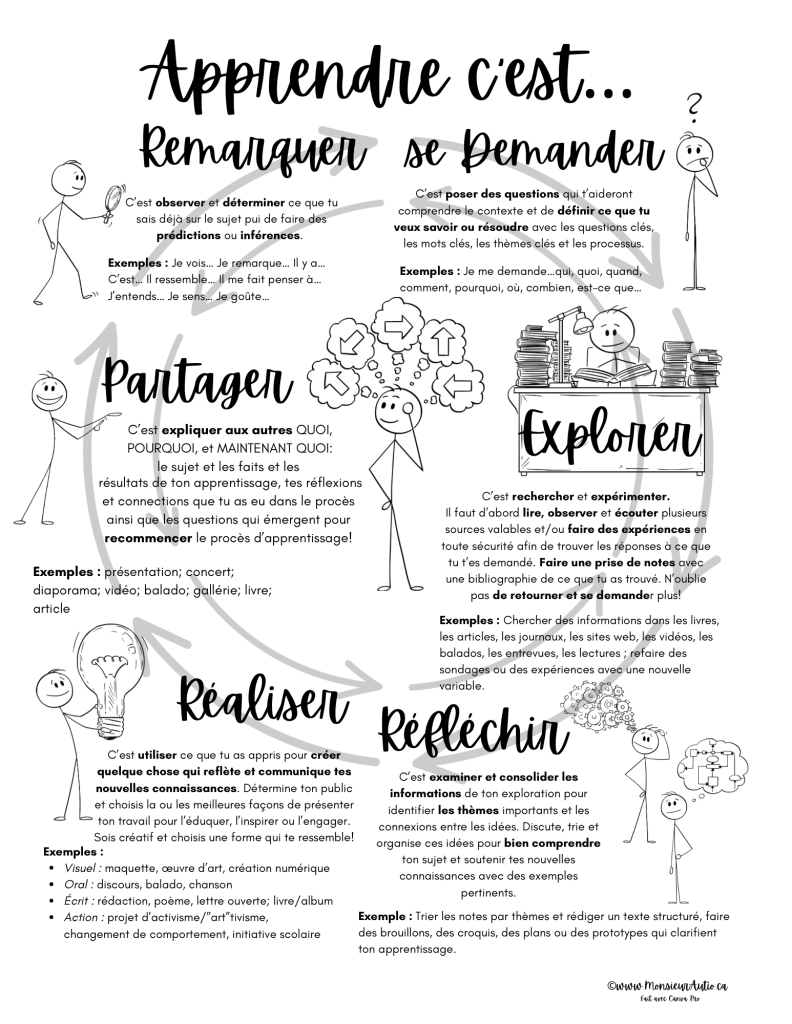

Consolidating Our Learning: Seeing Through Three Pairs of Glasses
For our final inquiry project for the month of June, students chose a topic that sparked their curiosity and explored it through three perspectives simultaneously: courage (examining examples of bravery and resilience), social studies (connecting the topic to society, culture, and history), and science (investigating scientific ideas or processes related to the topic). To introduce the project, I did a presentation where I had three pairs of fun glasses: heart-shaped glasses for courage, maple leaf-shaped glasses for Canadian society, and a pair of science safety goggles for science. As I introduced the idea of looking at their chosen topic in each perspective, I put on all three glasses on at the same time. I believe this helped them truly understand what the project was about!
This project encouraged a well-rounded and meaningful inquiry into something students were curious about and cared about as well as helped me assess students’ independent abilities in most curricular areas all at once, including content and skills in English and French Language Arts (reading, note-taking, synthesis, and oral presentation), engaging in a combined Social Studies and Science inquiry process, independently planning and setting goals for a deadline for Career Education, and creating or designing a product using skills in Arts Education and ADST. Of the nine curricular areas in BC, this project encompassed seven of them, save Physical & Health Education and Math, for which we had other projects and activities.
Some topics students chose included climate change, pollution, oil, airplanes, hydroelectricity, telephones, carnivorous plants, 9/11, the Great Chicago Fire, ballet, Emily Carr, Terry Fox, endangered or at-risk animals, tigers, sharks, bumblebees, and more. Students did an exceptional job overall and showed care and pride in their work, and the presentations showed that they all considered the three perspectives or that they could see the challenge in seeing one thing through three lenses and were able to make posters, models, art, Prezi presentations, bring in actual carnivorous plants, and more to showcase their learning. At the end of the year, many students said this was a highlight (along with Café 15) and were able to see their own courage in the ability to present and achieve their goals for the year-end deadline.
Conclusion
From teaching students through the idea of courage, I feel like I could understand my own thinking better when it comes to the Adlerian ideas I learned in The Courage to Be Disliked and The Courage to Be Happy. Collaborating and revisiting projects I’d done before with a new perspective was another act of courage for me and I was able to refine and share improved versions of myself and my projects. It was a way to live the integrity I preach: “We teach who we are,” as explored in The Courage to Teach and to reach our class’ objective: to learn and to improve.
This experience reminded me that courage is not only about taking bold action but also about being willing to question ourselves, listen deeply, and to be COAL. It takes courage to grow alongside our students and to model the vulnerability and reflection we ask of them and allow them to make mistakes and truly make the paradoxical place of learning (Palmer, 1998, Courage to Teach, p. 74) that requires risk and safety.
Where do you see yourself in my story?
How do you see the concept of courage showing up in your own teaching practice?
How might integrating social-emotional learning with academic inquiry, as in the three-lens project, deepen students’ understanding of themselves and the world around them?
Autios! À la prochaine!
Bibliography
Kishimi, I., & Koga, F. (2018). The courage to be disliked: The Japanese phenomenon that shows you how to change your life and achieve real happiness. Atria Books.
Kishimi, I., & Koga, F. (2019). The courage to be happy: True contentment is within your power. Atria Books.
Palmer, P. J. (2007). The courage to teach: Exploring the inner landscape of a teacher’s life (10th anniversary ed.). Jossey-Bass.
 Monsieur Autio
Leave a comment