
I often ask my students, « Qui est responsable pour ton apprentissage ?» – “Who is responsible for your learning?”
The answer is always « moi-même ! » – “myself!”
Responsibility, however, does not mean being alone. Students are responsible for reflecting, engaging, and taking ownership of their growth. My role as a teacher is to design and deliver meaningful learning experiences, guided by both the curriculum and my own gifts, and provide students with tools, structures, and systems to help them reflect and track their growth. Caregivers provide perspective and values that reflect family culture while also encouraging students and supporting them in their roles.
Over the next few blog posts I will describe some of the tools, structures, and systems I have developed over the past few years. Let’s start with one of my all time favorite tools I’ve developed- the Three Way Conference Pie.

Building Structures for Reflection and Responsibility
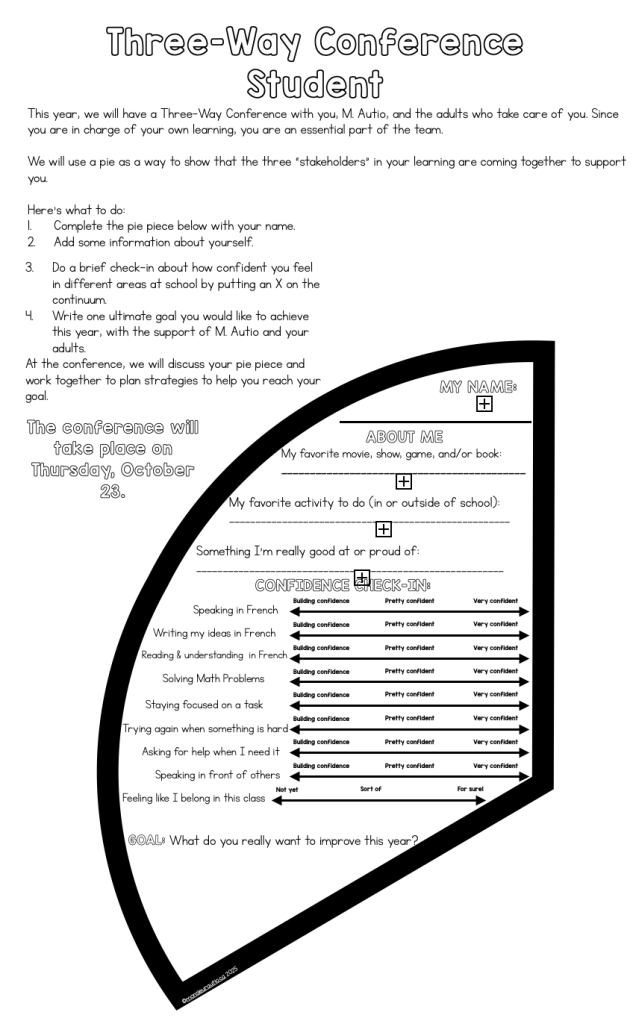
Over the years, I’ve developed systems that help students build metacognitive awareness and take personal responsibility for learning. One tool that has had the significant impact is the Three-Way Conference Pie – a visual representation of shared responsibility among the student, teacher, and caregiver. It has become my best seller on my meager Teachers Pay Teachers and one that a few colleagues have adopted themselves!
The design is simple: a pie chart divided into three equal parts. The circular shape represents wholeness and collaboration, reminding us that learning happens through partnership. The sections document student information, family perspectives, and teacher observations – from early learning behaviors to diagnostic data in literacy and numeracy.
Placed together, these pieces form a holistic picture of where the learner is and where we all want to go. It gets everyone on the same page – literally.
The Beginnings of the Pie: Aligning Beliefs with Practice
When I began teaching, British Columbia’s curriculum was shifting from content-heavy, grade-based assessment toward a competency-based model focused on reflection and growth.
My first district fully embraced this new direction. Teachers learned to use rubrics, co-create criteria with students, and emphasize growth over grades. As a new music teacher working across two schools, I began experimenting with self-assessment and student voice. Students helped co-construct success criteria for concerts and assessed their own developing music literacy using the new proficiency scale: emerging, developing, proficient, and extending.
Later, when I moved to a more traditional district, I experienced deep cognitive dissonance. I was asked to write letter grades after only one month of teaching nearly 500 students – some I had only seen for six hours total from September to their first report card. The idea of assigning a final mark under those conditions felt completely misaligned with my values.
That moment became a turning point. I began creating assessment systems that were both personally ethical and student-centered. I designed simple reflection sheets called “Me in Music” and built music portfolios that included student self-assessments and progress reflections. Interim reports became plain and parent-friendly with simplifying language to “on track” or “needs support” in place of nebulous letter grades and verbose proficiency scales thus inviting families into the conversation without overwhelming them. Assessment was no longer a verdict; it was dialogue with student voice being ever present.
Portfolios, Pies, and Progress
In my current district, this collaborative approach has deepened and is under constant refinement. Many families are highly involved in their children’s education, and students are ready to take greater ownership of their learning.
After my first traditional “parent-teacher conferences” in my current district, I noticed we left out the most important person: the learner. Though there was a list of “Questions you might task your child prior to our meeting” – the actual student was not at the conference to explain and advocte for themselves.
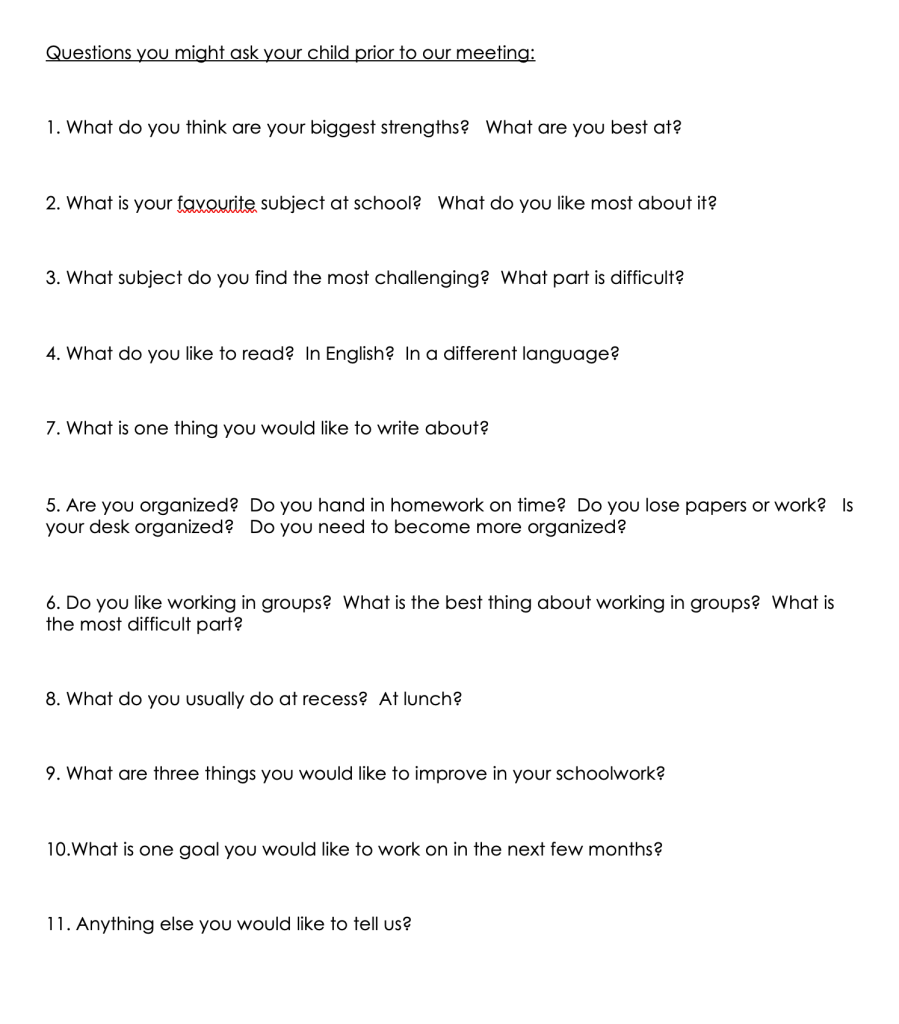
Today, I can’t imagine a conference without the student present. They are the ones who enact change, build habits, experience success, and deserve to hear their strengths acknowledged. That said, these are good questions that are mostly embedded into the Pie.
Three Way Conferences have been adopted and explained by several districts and jurisdictions and they are a part of British Columbia’s value of Communicating Student Learning versus reporting. This practice is also embedded into the Career Education and English Language Arts competencies and learning standards that emphasize reflection, self-awareness, and communication.
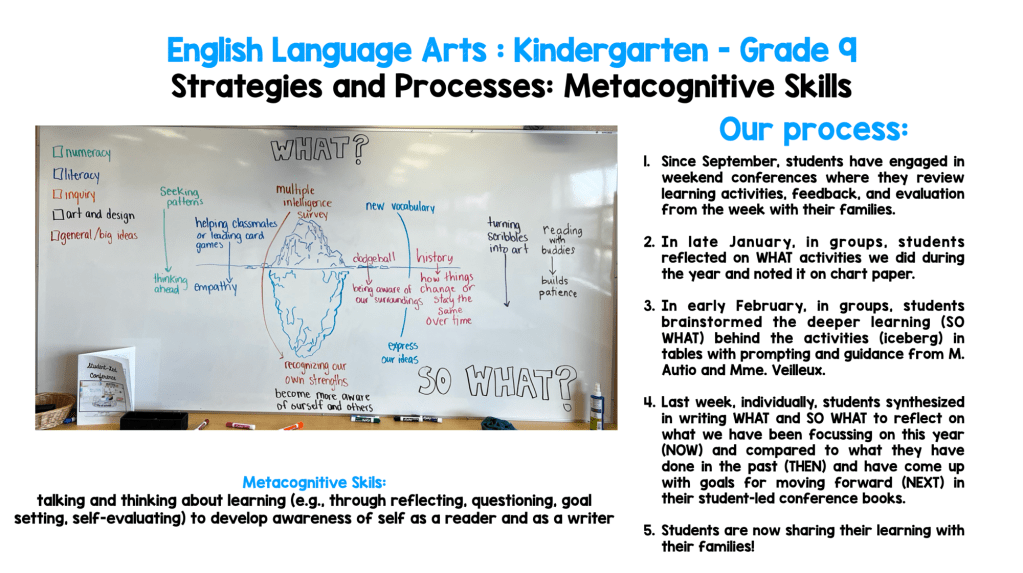
It also echoes a guiding principle from Kashimi and Koga: Whose task is it to learn? Whose task is it to encourage? Whose task is it to design learning experiences?
The answer, of course, is that each of us has a part to play.
The Evolution of the Pie
The original Three-Way Conference Pie began as a simple questionnaire for parents. After one year of these one-sided conversations, I shifted to a three-way format.
The circular design emphasized equal partnership. Over time, I added a student section for interests and goals, and a teacher section for strengths and stretches.
During the pandemic, the Pie became an essential communication tool, particularly when the Ministry required teachers to report on literacy and numeracy progress in the first term. Since then, the conference has become an official Learning Update – our district’s current iteration of a traditional report card.
The current version includes:
Student self-assessments on a continuum of confidence in key learning areas (see photo above). As the teacher, I am trying to gather some data now that we can revisit when we do our Student-Led Conference in the future (usually in February).
Parent reflections on academic and social goals and a place to add other information that may be helpful for the teacher to know.
Next year, I plan to add a simple but powerful question I used when I taught kindergarten: “What do you love most about your child?” The responses to this question reveal not only student strengths but also the family’s core values better representing the role of the family in the three-way picture.
Teacher summaries with “You can…” statements based on diagnostic assessments and check boxes of whether the student is “on track” or “in need of support” with the current learning standards. This year I added a place to make one overarching goal that summarizes the discussions we had during the conference.
⸻
Conference Flow and Roles
A clear structure helps keep the conference supportive and student-centered.
We begin with the student
- How has your school year been so far?
- What is working well for you?
- What is one thing you M. Autio or your caregivers can do to help?
I their portion of the conference by reinforcing student agency: If we don’t know what support you need, we can’t help you.
Parents or caregivers then share how they are doing with the weekly conferences where students review their binder and activities from the week and if there are any questions about what they see in the binder. Most respond that they are happy to see what is happening and more often wonder about homework expectations and how to support their child in French Immersion.
My homework expectations are that reviewing the binder is their main homework and that they are always encouraged to adopt French into their lives by reading, listening, and viewing French and that they may need to review and finish work that was not finished in class.
Then I go over the pie, reviewing each section and writing the conclusive goal for the year. I keep the pies and make a copy (scanning using a scanner app this year has been a game changer!) and then thank parents for coming. Then we do it all over again!
The pie outlines my beliefs on learning and shows each stakeholder’s role as well as communicates and summarizes learning up to that point with actionable goals for the future.
⸻
Looking Ahead
The Three-Way Conference Pie has evolved over the years, but its purpose remains constant: to center the student’s voice in their learning journey.
With clear structures and routines in place, assessment becomes less about judgment and more about connection. It becomes a shared practice of clarity, responsibility, and encouragement and growth over time. Easy as pie!
The pie is but one piece in my systematic assessment. In subsequent blog posts you will read about my favorite post-experience reflection, binder system in more detail as well as the student-led conference and student-made learning up dates (report cards). All of these work together to form systematic assessment that not only is valuable to all stakeholders but also streamlines my workflow!
⸻
Where do you see yourself in my story?
How would you define the roles of teacher, student, and caregivers?
What systems do you have in place to help you with your assessment?
What are some tools, systems, or structures you are missing in your current assessment practice?


 Monsieur Autio
Leave a comment