
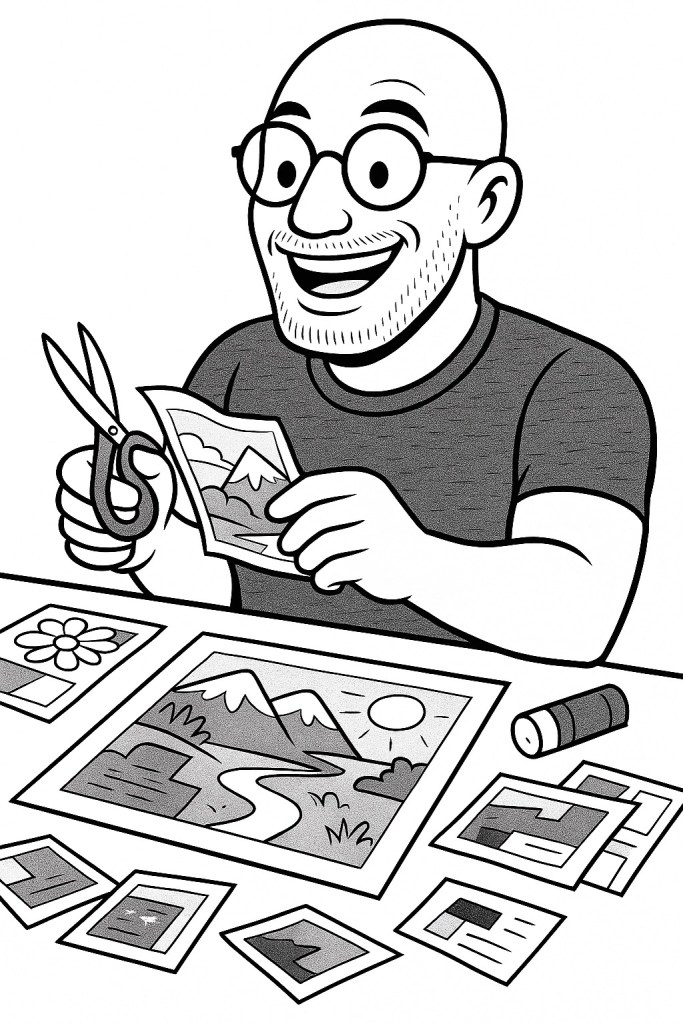
I am a pastiche of other teachers. I imitate and am influenced by many teachers from my early schooling, my professors and mentors, my colleagues, and my friends and family. I have gathered countless clippings of ideas, phrases, stories, and strategies over the years to develop my current understanding of what it is to learn and teach. Pasted together, what I have learned resembles a collage that forms my current understanding. Ideally, a report card should function in the same way—clippings from a variety of experiences that show what a student knows and can do.
What follows is how I have come to view reporting: the summarizing aspect of assessment, and how I piece together a student’s learning to update and communicate with families and the government.
Bridging Reflection and Reporting
As I mentioned in Part 2, at the beginning of the school year I have students set up their binders, and to decorate them we make a collage. Beyond what I have already described about its function to scaffold the W3 process, it is also a precursor to researching: searching and gathering information based on a question or criteria (what images represent you and your interests?), sorting information, presenting or sharing it, and reflecting on the process.
This process is also applicable to what teachers do when we write each student’s summative Learning Update or report card in British Columbia. We gather information about students’ abilities from various sources (learning experiences, assessments, evaluations, observations, and conferences), sort them into clear learning statements based on the curriculum, and present them in the form of a summary based on our professional judgement of students’ abilities to demonstrate a blend of competencies and content.
British Columbia may be unique in this blending within our current curriculum. Our union, the BCTF, has afforded us the privilege of significant teacher autonomy. That, combined with a curriculum that is more competency- and process-based, makes the system highly fluid and open. For teachers like me, it allows me to be highly creative and critical; it affords me the right to teach in an interconnected way and to help students build their Core Competencies, which ultimately aligns with my own beliefs about helping students self-actualize. I can easily use the curriculum and the First Peoples Principles of Learning as a launch pad toward meaningful learning experiences.
For some other teachers, however, there remains a lack of understanding, direction, and shared standards when it comes to curriculum implementation and reporting. Herein lies the challenge of interpretation and standardized quality. There are few Ministry or District mandates when it comes to programs, resources, or standardized testing to ensure that the curriculum is being delivered as designed—something the BCTF advocated for after years of standardized testing (through which I lived as a student up to 2006). As a result, it is largely through reporting orders that teachers are held accountable to the government and the public that the curriculum is being delivered.
The most recent reporting order requires strength-based language that is easily understood by parents and families, a “next step” for each subject area up until the final Learning Update, encourages student voice, and allows for the use of proficiency scales in place of letter grades—another practice that is less common in other jurisdictions and often less familiar to parents.
Once it is all said and done, it is clear that writing a Learning Update is no longer a matter of entering a letter grade and a short comment. They are much more descriptive and, hopefully, more useful to families. The intent is to provide a better reflection of what students have learned compared to a single letter, number, or symbol attempting to capture the depth and breadth of their experiences. It reflects our society’s growing value of process over product.
From my point of view, the Learning Update serves multiple purposes: it updates students and families on a student’s current level of proficiency at that moment (it is a snapshot), and it serves as an accountability piece, as it is an official government document demonstrating not only that the curriculum is being delivered, but how a child’s learning profile fits within those skills and content. This becomes particularly important as we track student growth over time and reference Learning Updates when building student learning plans for children with complex learning needs—which, from personal observation, seem to be on the rise. One primary challenge, then, is translating teacher-facing curriculum language into plain language, incorporating student voice, and ensuring there is enough meaningful information for families and future teachers to understand a student’s learning profile.
This is not an easy task. How is one supposed to synthesize months of individualized experiences and provide professional judgement—evaluation and assessment—on each individual in each subject area? This takes a great deal of mental effort, and little to no paid time is provided to complete report cards. And yet, they always get done. Now, with AI, the synthesis has become significantly easier.
My System to Simplify Summaries
Through the years, my report cards (now called Learning Updates) shifted from long paragraphs to point form. Initially, I felt as though I was having to justify everything I was doing to parents, when in reality I was more often trying to justify to myself that I was doing my job well. Eventually, I realized that the Learning Update is meant to be a summary—a quick glance at what we have done and where we are going next—and that point form was not only faster but much easier to understand for everyone. Each reporting cycle, I began to find systems and strategies to make the process more efficient and to meaningfully involve students. After all, they are the ones who learned, and I need their perspective to truly understand what they knew.
Over the past three years, as AI has become more ubiquitous in daily life, it has been a powerful tool for sifting through the BC curriculum and generating learning standards that align with the experiences I design. What once took hours of careful word crafting is now streamlined, allowing me to focus on using clearer, more accessible language for students and families. This transparency helps reduce student stress and makes the reporting process more understandable.
With AI, generating personalized learning standards based on government proficiency scales has never been easier. By prompting AI to generate learning standards (curricular competencies combined with content) in the form of “I can” statements, and further prompting for proficiency scale rubrics written in simple language that reflect Bloom’s taxonomy, I save countless hours. The rubrics use the pronoun “you”—“You can…”—which makes each Learning Update feel personal and direct.
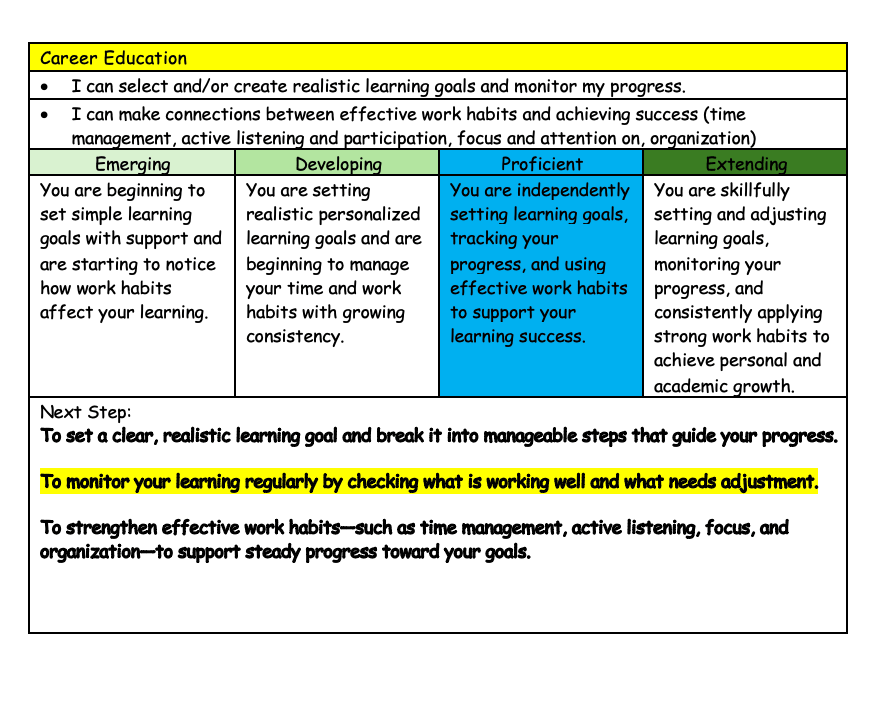
From these rubrics, I create a handout (now a Teams Word document) where students self-evaluate their proficiency in each subject area. I remind them that while “proficient” is the goal, it is okay to be elsewhere on the scale. They often ask if it is acceptable to be “in between,” and of course it is. I encourage them to highlight both sections they feel they are straddling. In the case below – I would phrase their standing as “You are showing early levels of proficiency in this area of learning. You…” to show that they are just beyond developing. Ideally the BC government would have a “early proficiency” standing as many students find themselves in this situation, particularly in the early parts of the year.
After choosing an overall proficiency based on the “I can” statements, students select a “next step” from another generated list aligned with the same statements, with space always provided for them to write their own.
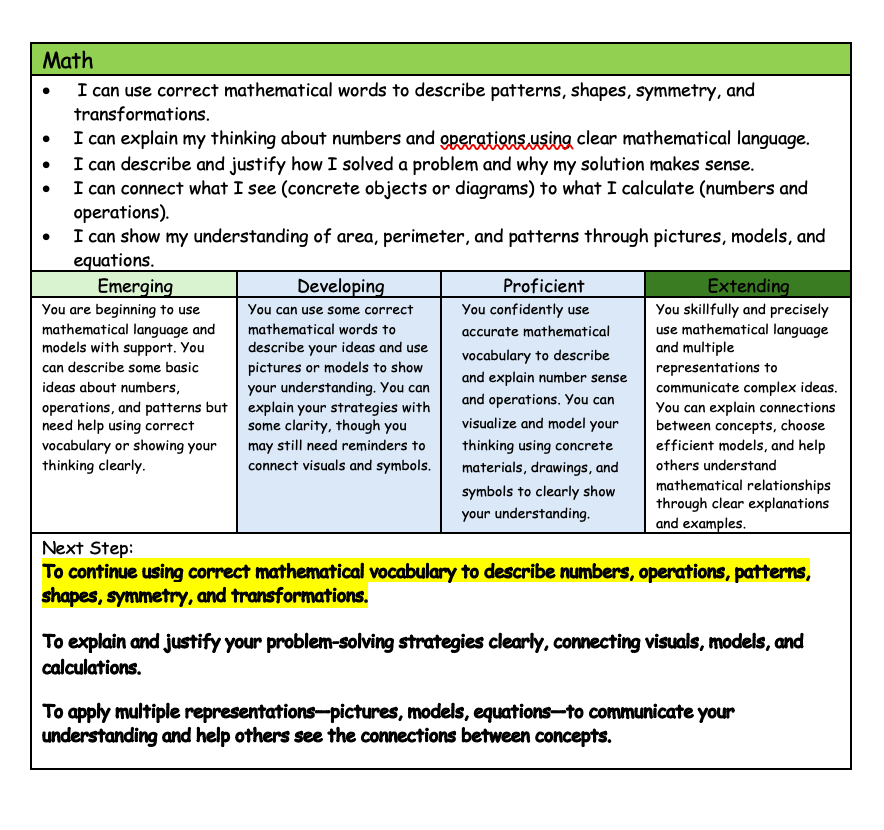
Their self-written Learning Updates provide me with valuable insight, and more often than not, their self-reflections are accurate. Only occasionally do I need to add more specific next steps based on my own observations and data. From there, it becomes a straightforward copy-and-paste process into MyEducation BC, the provincial education database.
Like a collage, the experiences and data I have designed, gathered, and shared with students are then synthesized into “I can” statements that students recognize as their own learning.
For the opening comment, a similar process is used. These comments typically focus on learning behaviors, so I again ask students to identify their strengths and areas of stretch based on an AI-generated list of general learning behaviors. As always, if they feel their word is missing, they are invited to add it.

I will then prompt AI to help generate a comment based on their selections initially with a number (to circumvent privacy and information protection challenges) and then add their names at the beginning of the opening comment. Again, this saves a lot of time that I can give back to students in the present moment.
First Look
After my administration approves my updates, when time allows, I try to show students their Learning Updates before they are sent home and ask, “Are there any surprises?” There rarely are. Sometimes students question a proficiency level or ask why it differs from their own assessment, which opens space for me to share my observations and evidence. Other times, they catch a genuine clerical error, and I correct it immediately. The result is that there are no surprises—students know what their Learning Update will say and understand their next steps. The hope is then that reporting is not an “event” (think of the nerves you had receiving your report card in a sealed envelope) but just another part of your day-to-day learning.
A Learning Update, then, is not only a snapshot but a carefully selected clipping of a moment in time, offering information to students, families, and the government about where learning stands at a particular point. What is peculiar about Learning Updates is that they are composed of reflections on the past and intentions for the future. The traditional value placed on the final document can still privilege result over process, often pulling attention away from the present moment—the only place learning can truly occur.
Conclusion
In the end, a Learning Update is a collage. It is made of moments already lived, language borrowed and reshaped, observations clipped from the everyday, and reflections offered by the learner themselves. It is never the whole picture—only a carefully arranged selection.
As the years go on, I am learning to hold this collage more lightly. To spend less time perfecting the arrangement and more time living the moments that will eventually become part of it. Reporting matters—but not more than the present experience and not more than the human beings in front of me.
If the Learning Update does its job well, it offers information without judgement, direction without comparison, and reflection without fear. Like any good collage, it invites us to look closely, then step back, and remember that learning is always still in progress, that it overlaps, and that it has rough edges and can sometimes be sticky and imperfect.
Autios! À la prochaine!
Where do you see yourself in my story? Leave a comment below!
What are some report card “hacks” you have found?
What are some ways you want to transform the “reporting” experience for yourself or your students?
What was your biggest take-away from this post?


 Monsieur Autio
Leave a comment