
Maestro, if you please
Does anyone remember the Maestro from Seinfeld (season 7, episode 3)? He was an over-the-top conductor who insisted everyone call him “the Maestro,” a grandiose title that didn’t quite match his role as a community orchestra conductor.
My family loved Seinfeld, and somewhere along the way I also became attached to the idea of maestro as a title eventually claiming it for myself online.
The word itself is interesting. Depending on context, it can refer to both an elite conductor or a primary school teacher. I have never reached elite status as a conductor, but the name still feels fitting—a music-loving elementary school teacher who, like the comedy of Seinfeld, tries not to take himself too seriously.
Learning to Conduct
My sense of myself as a conductor has been developing for a long time. Since joining band in grade 8, I have always been drawn to conductors. My first experience on the podium was in Grade 12, conducting a Grade 8 band through one of my first pieces, Mission: Impossible. There was something powerful about guiding a group toward performance and my band teachers remain some of my most beloved teachers.
As a teenager, I remember my mom returning from a healthcare conference excited to share something she had learned about conductors and leadership: conductors are the only people in the ensemble who do not make a sound. At the time, I did not think much of it, but the idea stayed with me. This idea continues to provoke how I think about teaching, and it is something I now share with my students as a way to encourage them to sing and make musical decisions more independently.
Reflecting on that now raises an important question: If students are the ones doing the learning—the playing—then what is the role of the teacher?
A conductor has many roles: they guide, inform, shape, and make decisions, to name a few, but the music ultimately belongs to the ensemble. At the same time, the role carries a kind of authority that can easily shift toward authoritarianism and ego if it is not grounded in humility and authenticity. This distinction was recently brought back to mind during a conversation with a dear mentor, Ardelle, and is the inspiration for this post. What I realize is the same tension exists in the classroom.
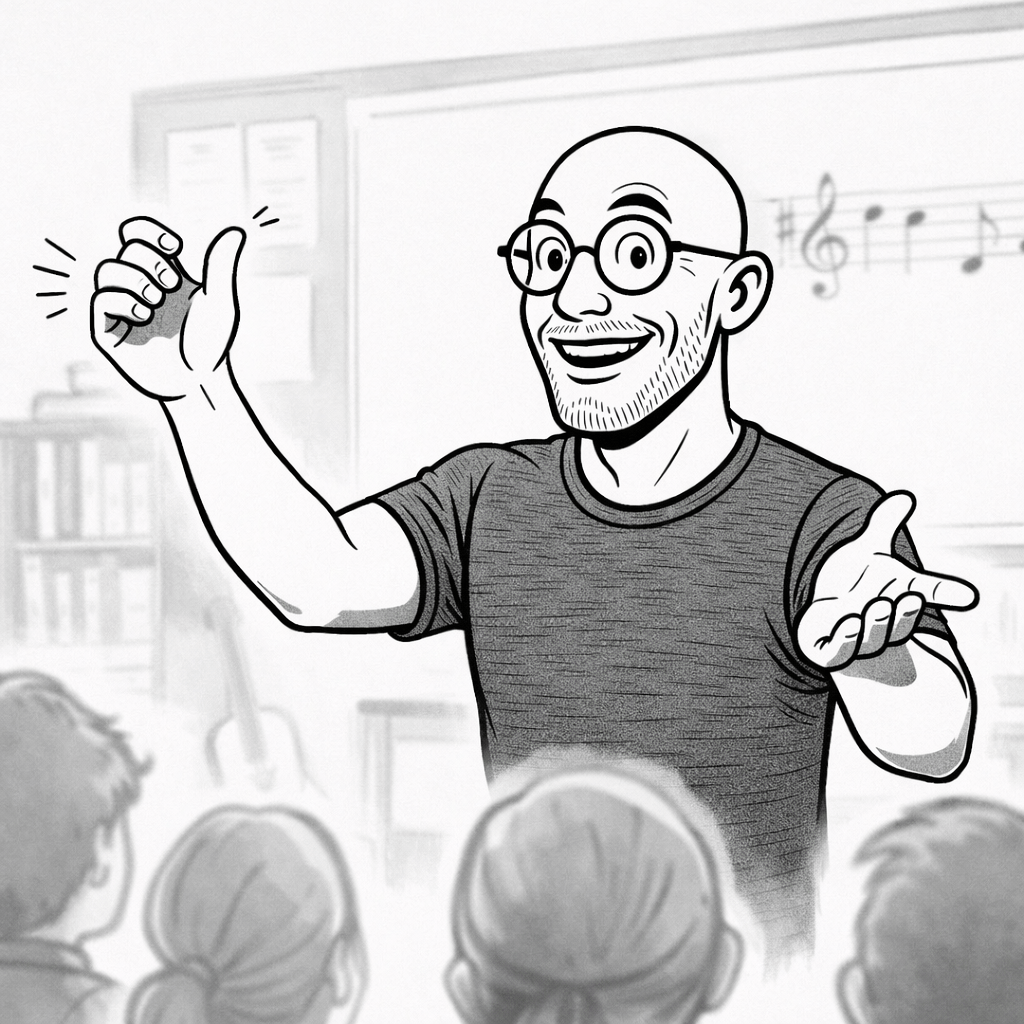
During my time at the University of Victoria, Wind Symphony conductor Gerry King often said, “We are independent musicians working interdependently.” This idea continues to resonate with me as I think about the classroom as a community of learners. This ideas has been found in my mentor texts (Katz, 2018; Kishimi & Koga, 2019a&b: Palmer, 1998) and will be explored through this post.
Several shifting ideas were planted during my education courses in university including the idea of what education is and what it should or could look like. Challenging ideas of grading and marking for the upcoming “New Curriculum” in BC, learning about democratic education and the oppressive undertones of our education system (even questioning the ethics of grading participation and the power dynamics of students raising their hand to speak!) as well as learning of Canada’s darker history with First Nations — namely residential schools and the 60s scoop. All of these provocations raised profound philosophical questions of what my role would be in creating an ideal classroom environment for learning.
Shifting Questions
What does a great classroom, or ensemble, look like, sound like, and feel like?
My late elementary music practicum mentor, Darlene, framed her year around these questions, and I have carried them with me ever since. Even then, I began to see glimpses of a more democratic approach to education. Never once as a student had I been asked what I wanted in a classroom. It felt revolutionary and like the theory I learned about in university was being put into action!
At the same time, Darlene used a behaviour chart to track student actions through a point system. It worked well for her. She would either reward students during the lesson who were listening and all would self reflect at the end of a lesson and give themselves a rating. I tried to adopt this early in my career, but I quickly realized I was not consistent. More than anything, I would forget—or apply it unevenly.
Nowadays, social media is saturated with systems that promise engagement and compliance—class economies, marble jars, tracking charts, reward systems, to name a few. I remember experiencing similar systems in elementary school, particularly for motivating each other to speak in French: les bâtons, les blocs, and a class economy leading to a class store (where I once bought one of those huge pencils you would never be able to sharpen again!).
I now find myself questioning what these systems are really doing.
While they may produce short-term results, they risk narrowing the purpose of the classroom to something transactional rather than relational. In all cases the systems that many of us experienced as well as that are pushed by influencers require buy in from all students. But, what is the cost if a student decides not a follow the behaviour management system?
Perhaps the most challenging aspect of learning of Adlerian psychology according to Kishimi & Koga (2019 a & b) has been the idea of “Do not praise and do not rebuke” (2019b, p.69). The argument is based upon power dynamics, democracy, and the ideas of agency (2019b, p. 66). However, this challenges me to reflect on many, if not all, our systems and structures in education.
An Underlying Question
Through an Adlerian psychology (according to Kishimi & Koga,2019 a&b) lens I have begun asking a different set of questions that relate closely relate to the looks like, sounds like, feels like: What is my task, your task, and our shared task? Which leads to an underlaying question: Why are we at school?
According to Kishimi & Koga (2019b) Adler’s view is that “the objective of education, in one word, is self-reliance” (p. 15) which echos Katz & Lamoureux’s (2018) vision of an ensouled education:
Our souls is the core of who we are, our humanity, our essence. Soulful education is about self-actualisation – discovering who we are, where our passions lie, and what gives our lives meaning and purpose… An ensouled school recognizes the needs of all human beings for connection, appreciation, respect and meaning (p.13).
My current answer I state to students at the beginning of the year is now, “We are here to learn and to improve.” From this statement I hope to establish a context in which we all live though at this point I recognize it is not democratically determined, my students seemingly agree so far.
More specifically to French Immersion context, in my attempts to avoid praise and rebuke, I state that to learn and improve in another language we need to make an effort to speak it more than other languages.
My phraseology has shifted from “parle en français!” (Speak in French!) To “plus de francais que l’anglais” (More French than English) and sometimes even “plus de francais qu’autres langues” (More French than other languages) for my students who speak other home languages together. I also pose “quelle langue sommes-nous ici pour apprendre ?” (What language are we here to learn?). My intention behind this shift is to avoid charts, games and competitions (that I can never seem to follow through with) and shift towards a more realistic reminder. Therefore, in place of praise or rebuke I hope to uphold accountability.
Through this example and others like it, I am slowly shifting my class “rules/standards/expectations” towards shared class principles and contextual agreements that both students and teachers live within while we are together. I admit there lacks a full democratic process which is to be my next step.
My current goal is to build a shared understanding that we are all learning and improving helps shift from a vertical relationship to a horizontal equal plane (Kishimi & Koga 2019a, p. 72; 2019b, p. 125).
Making these Abstract Ideas Concrete Actions
To enact this principled context I consider my task as the Maestro to design the learning environment that is both physical and felt.
The physical environment matters. As the teacher—or conductor—the way the space is organized shapes how students experience learning. Yet, the “Pinterest classrooms” see on social media are not necessarily the standard we should be striving for.
During my practicum, I observed a teacher, Judy, who began the year with blank walls and desks in the hallway. Students brought them in themselves, symbolizing ownership of the space and over time, the walls and room became a reflection of the learners and their learning together.
This ties ideas I learned from a Sarah Ward’s workshop in 2020 on executive functioning: to have minimal clutter and dedicated zones in the classroom based on topic. She recommended to only add anchor chats and resources to the space only after you have introduced them and you need them. This worked so well with Judy’s routine.
I do my best to implement these strategies. Every year I strip my walls and rethink think carefully about the flow of the room, the organization of materials, and clarity of routines and ways we can be efficient as a group. Through the year it changes and adapts to the group’s needs. Last year For almost a month we set up the room to single rows of chairs and clip boards as we prepared for a performance and the class responded positively to the lack of distractions beyond the one thing in front of them that we continued longer than needed in that formation.
But systems and set up alone are not enough.
They only function when they are understood collectively. That requires explicit naming of the reality of our context: There are many people sharing this space so how do we create an environment where everyone can learn?
From this the reasons why we listen when there is someone speaking, why we should push in our chairs, why we put our materials away and why we keep our personal belongings organized are are less about teachers control but communal living in a small space.
In many ways, this mirrors an ensemble. Routines, rehearsals, cues, expectations alone do not create music. They create the conditions in which music might emerge as a collective. If the space is not set up with proper equipment and sight lines and groupings, the conductor and the musicians cannot cooperate optimally.
Naming the Distinction: Classroom Manager vs. Classroom Leadership
Although often used interchangeably, there is a meaningful distinction between leadership and management: Management is structure, organization, consistency and leadership is vision, direction, inspiration (Gavin, 2019). In practice, teaching requires both.
A conductor must prepare for rehearsals and guide the music but keeping time is not the same as making music. Similarly, students can follow expectations without critically thinking for themselves and truly learning.
The term classroom management has become synonymous with behaviour management which often means compliance. Compliance is the opposite of critical thinking and learning.
After reading Kishimi & Koga (2019a&b) I ask myself, “Who is ultimately responsible for student behaviour?” The student. How can we teach students the context rather than punish or manipulate to compliance? Are there times and places for such measures? Do those measures align with the values of leadership and democracy? Can they ever be used in a “horizontal” or equal relationship or will there always be a “vertical” power dynamic?
I do think a classroom manager should maintain order through establishing routines and organizing systems and structures. Structures help us know what to expect in a given context and are necessary to group management and administration and are a part of Universal Design for Learning. But when management becomes primarily about behaviour control, it can limit both students and teachers. When creating a physical classroom environment, how can we maintain our leadership values?
A classroom leader should create shared purpose, model values and build relationships.
I now can see the distinction between classroom management and leadership being physical and feeling: management is the physical while leadership is the emotional. Leadership is less about directing every action and more about modelling and upholding the values of a group and creating the emotional conditions where these values can be lived. Palmer (1998) writes,
Good teachers possess a capacity for connectedness. They are able to weave a complex web of connections among themselves, their subjects, and their students so that students can learn to weave a world for themselves (p. 11).
The phrase often said in University was “don’t be a sage on the stage but a guide on the side” became cliché but more and more I see it as like two of Palmer’s both/and paradoxes “1. The space should be bound and open…4. The space should honor the ‘little stories’ of the students[and teacher]and the ‘big stories’ of the disciplines and traditions [subject]” (1998, p. 74). Teaching requires one both the sage and the guide— leader and manager: Direction and management of space and structures both to guide as well as the sage leadership to share our gifts and perspectives as teachers. Let’s face it, at the end of the day, teachers should be sages with wisdom and perspective to share!
In musical terms: sometimes we play and sometimes we rest and listen. Knowing when to be in the foreground and background of an ensemble is skill every musicians must learn and know.
What matters is not choosing management over leadership, but knowing when each is needed. This is part of the art and practice of teaching.
Progressively Practicing Presence
For years my personal mantra and meditation has been “may I be patient, kind, generous, and humble” yet I still have had moments in my career and life where I have lost my cool or lived in a state of anxiety. More often than not, these have been the times when I phoned my family or friends with shame, guilt and self-doubt. I name these times now as not being in line with my core values — my mantra and realize the ego at work: the need to be seen as competent and in control rather than being truly responsive to the moment before me. Tolle (2002) explains,
To the ego, the present moment hardly exists. Only past and future are considered important… It is always concerned with keeping the past alive, because without it —who are you? It constantly projects itself into the future to ensure its continued its survival and to seek some kind of release or fulfillment there (pp.18-19).
It has taken years of self-actualization through reflection and practice to get to my current conclusions. That said, I still experience moments of annoyance and botheredness that take me away from my present moment — I’m still human, after all!
What is changing is my relationship to those moments. Rather than getting frustrated in attempts to eliminate them, I am learning to pause step out of the situation notice my ego, and practice counselling strategies like breath, COAL (to be Curious, Open, Accepting, Loving of the current situation) and upholding dignity and respect for myself and others. The more I do the more I realize that my frustration comes out of ego and fear of being disliked or called out for being a fraud or a bad teacher.
As I continue to practice my arts of teaching and conducting I am finding greater joy and peace in my job. Every year as I refine my practice I gain more job satisfaction and feel that I can be creative and comfortable in my job. I am challenged to be the best version of myself and I encourage my students to do the same. By sharing my process with my students though values-driven activities and awareness of the “why” and context behind activities and structures I notice an increasingly positive classroom environment where everyone can learn. We all make mistakes but we learn from them and move forward equally (but not the same!).
Some flubbed notes do not make for a ruined or heartless performance, but a human one. My less- than-best moments do not make me a heartless teacher but one that continues to practice and refine. How I model my growth is a way to inspire, lead, and teach my students and remember the respect needed to build “community feeling” (Kishimi & Koga, 2019b, p. 30) of independent people working interdependently.
The striving for growth and improvement are what make elite musicians and students and it is the maestro who must manage and lead them towards their own independent striving for an interconnected society.
Where do you see yourself in my story?
What are some behaviour management strategies you’ve either experienced or use?
What are your cornerstone management systems and leadership values?
What has been something that has been percolating since you first started teaching that is beginning to reveal itself as truth?
References
Katz, J., & Lamoureux, K. (2018). Ensouling our schools: A universally designed framework for mental health, well-being, and reconciliation. Portage & Main Press.
Kishimi, I., & Koga, F. (2019a). The courage to be disliked: The Japanese phenomenon that shows you how to change your life and achieve real happiness. Simon & Schuster. Toronto.
Kishimi, I., & Koga, F. (2019b). The courage to be happy: The Japanese phenomenon that shows you that true contentment is within your power. Simon & Schuster. Toronto.
Palmer, P. J. (1998). The courage to teach: Exploring the inner landscape of a teacher’s life. Jossey-Bass.
Tolle, E. (2002). The power of now: A guide to spiritual enlightenment. Namaste. Vancouver.
Gavin, M. (2019). Leadership vs. management: What’s the difference? Harvard Business School Online. https://online.hbs.edu/blog/post/leadership-vs-management
 Monsieur Autio
What do you think?