
This week I was challenged to think about how to leverage technology to foster a reading culture in a school which is funny because sometimes I joke that I don’t read. What I’ve realized about myself is that I consume literature differently thus my musings draw on how I continue to be a literate person who teaches literacy to kids as someone who perhaps only “reads” less than five whole printed books a year.
Audiobooks are my go-to medium for consuming books I still enjoy news apps and printed books when the mood strikes. I often listen to books while driving or working out, and if a book really resonates, I’ll procure a physical copy to annotate or reference later and sometimes read along with the audiobook. The ideas from these books often show up in my blogs, articles, conversations, and more often than not in the way I teach. I’m typically drawn to self-help and professional development titles—the kind that tie into my ongoing self-actualization journey including my courses im taking towards my Teacher Librarian certificate and to become a certified personal trainer. All of my learning in these courses help me make connections I can bring to my students.

Before this chapter of my life, I was more into fantasy and mystery. Like many of my generation, I was engrossed by the world of Harry Potter before the movies and before the current controversy around J.K. Rowling. That series may have been the last time I read every word, cover to cover, multiple times. Now, honestly, reading print puts me to sleep! I still am drawn to these genres now predominantly through audiobooks my dad recommends.
Audiobooks changed everything. My dad, a retired electrician, listened to them on the road long before apps existed; I remember road trips with JRR Tolkien’s The Hobbit on cassette. Now, we share an Audible account and swap recommendations regularly. On another road trip I found my favorite novel, A Prisoner of Birth by Jeffrey Archer. I’ve read and listened to it more than once, each time bringing back great memories of leaving a party early to listen to the next chapter with my mom in the camper! My current favorite series is the Thursday Murder Club series by Richard Osman. The characters are brought to life with the narration and even Osman says he writes with the audiobook in mind.
Preferences and Beliefs About Reading
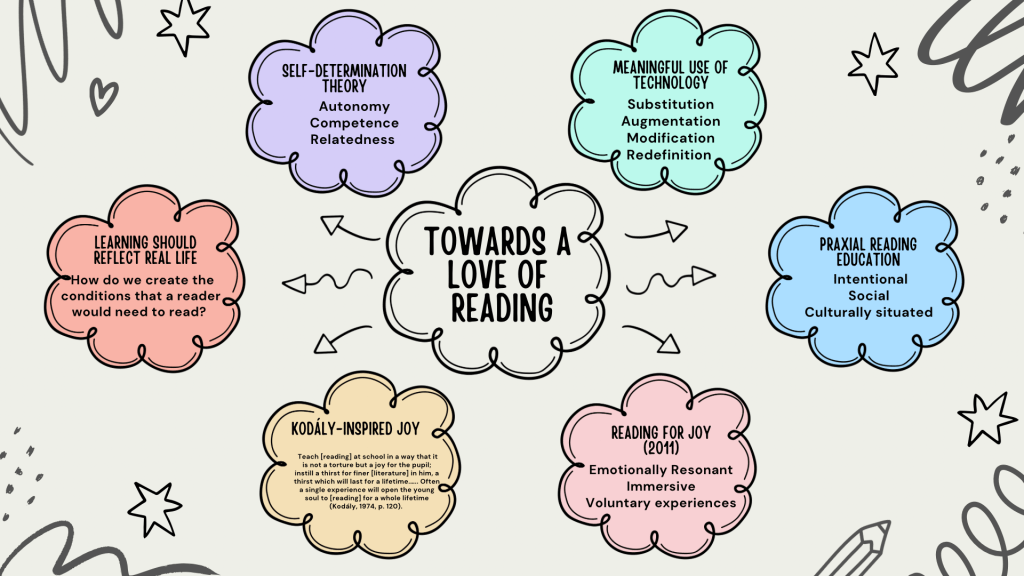
My preferences and beliefs about reading ultimately will inform how I inspire my students and foster a reading culture in my community. I often think back to some of the roots of my beliefs about teaching reading and literacy and much comes from my time in university. My education philosophy professor, Dr. Jason Price, emphasized that learning should mirror real life, a statement I have taken to heart and try my best to practice through such experiences as Café 15, a night where we share plays and music from the year with our families, and social justice projects like a charity fair and “artivism.” This along with my education at the UVic music education faculty whose philosophy and approach was a praxial philosophy of music education where “musicking” is intentional, social, and culturally situated (Elliott, n.d.) and Kodály-inspired music education where Kodály himself said,
Teach music and singing at school in a way that it is not a torture but a joy for the pupil; instill a thirst for finer music in him, a thirst which will last for a lifetime.….. Often a single experience will open the young soul to music for a whole lifetime (1974, p. 120).
In all, there is no difference between fostering a culture of language literacy and music literacy and my own preference of reading-by-listening leads me to my intention and solution to this week’s challenge.
Reading That Reflects Real Life
As someone who calls himself a “non-reader,” how do I help students develop a joyful, lasting reading practice that emulates how readers actually read?
Research like Reading for Joy (2011) makes it clear: lifelong readers aren’t made through tests or pressure, they’re formed through emotionally resonant, immersive, and voluntary reading experiences—where they lose track of time, see themselves in characters, and feel free to explore. In another other word, joyful, not a torture.
Unfortunately, many forces work against that joy: testing, curriculum overload, reduced library resources, home support gaps, and screen culture. Likely many students do not have a dad like mine who would be reading when I woke up and listening to books as he drove. But I believe we can push back—by modeling a love for reading and creating a culture where students feel seen, capable, and connected.
In the Library/Learning Commons could look like:
Emotionally Resonant: Have a variety of books that students can choose in a medium they resonate with. An activity that comes to mind comes from the the French saying for an “all time favorite” is a “coup de cœur” which literally translates to “strike of the heart”. A school library challenge could be to “find the book that makes your heart sing” whereby we invite students to find and share their absolute favorites and why. This could be shared on a district-approved platform (SpacesEdu, Google Classroom, etc.) or even on a library TV/screen/tablet that students can interact with (ie. a school-based social media)
Immersive: Bring the books to life by adding different media like sound and visuals! This was something I experienced in my music education class, adding Saint-Sean’s Aquarium to Pfister’s Rainbow Fish (1992) or adding musical sound effects with xylophones or other music-making apps like when Mortimer’s family goes up and down the stairs in Mortimer (Munsch & Martchenko, 1985). Visuals could be generated by AI or simple backgrounds could be added like that of an aquarium, forest, or whatever the setting calls for. Even this year I started to play instrumental music during silent reading and one student said, “the music completely lined up with the battle scene in my book!” And when I read by myself, I often put on instrumental music while I have a coffee in a comfy chair.
Voluntary Reading Experience: Sometimes all we need is space, time, and choice. Having digital resources on our library websites, QR codes to audio books, having the technology to be able to consume literature how we want as well as just an open space to actually read is perhaps sometimes all we need to provide. A student of mine this year prefers reading from an e-reader, so having options for students to upload books to their e-readers is a consideration.
Radio Canada has a fantastic website full of free French audio books that could be a starting point and have several titles that many French Immersion schools would already have.
Reading Motivation: Lessons from Fitness and Sunday School
As I study to become a personal trainer I learned about the Self-Determination Theory (Di Domenico & Ryan, 2017), which says motivation flourishes when three needs are met: autonomy, competence, and relatedness. The ideas align well with my other current inquiry on Adlerian psychology via the book The Courage to be Disliked (Kishimi & Koga, 2019) who explain Adler’s views that all behaviours are a choice. I can see what is true for fitness is true for reading.
What this could look like in the Library/Learning Commons could be:
Autonomy: Autonomy relates closely to the Reading for Joy (2011) recommendations while more focus on the part of the Teacher librarian on competence and relatedness could help foster a more robust reading culture. Like Voluntary Reading Experiences, offering students choice in format and genre—print, audio, graphic novel, online, e-reader etc. allows for students to build autonomous reading skills rather than prescribed reading for “learning” or mechanical exercises.
Competence: Making reading about celebrate growth through achieving goals and effort, not just reading level, length, or minutes. This is something to retain to help make reading personally meaningful rather than comparative and competitive. This is where reviewing SMART goals may come into play making the goals. Technology could be used as a way for students to track their measureable data (minutes, length of book, number of books, days of week reading, series read, levels on an app, etc.). That being said, for some, gamification and competition may be helpful to some however it should be optional to remain autonomous competition may detract from the true love of reading.
Relatedness: Having students make personal connections to the books they read through reflection helps build the loving relationship with reading. When we talk about the lessons we learn from books and they relate to our lives and other learning (like my thematic teaching based on Lyster’s research (2016)!) we start to build a reading culture that is personalized and interconnected.
One question set I have adopted for my classroom literacy program that helps support reflection are inspired by Jerome Berryman’s Godly Play (2002):
“I wonder what part of the story you liked best?”/“What was the most important part of this story?”
“I wonder where you are in the story?”/“Where do you see yourself in this story?”
“I wonder what we could leave out and still have all we need for this story to make sense.”
These secular questions invite joy, depth, and self-connection—all of which make literacy meaningful. They helped me when teaching values-based stories to my students in Sunday School and they can be relevant to any story. I notice myself mostly thinking about “where do I see myself in this story?” When reading and listening. In other words, how can I personally connect to this? Where am I being reflected and what does this story have to teach me?
These questions could anchor students’ reflections and could be shared on student blogs, podcasts, videos where they review and share their impressions on the books. Potential art projects abound with photography, digital tools to create graphics and animations (ex. Stop motion) or even videos of students acting out scenes using simple apps like Apple’s Clips. This is where the collaboration with classroom teachers is essential as they would potentially adopt and reinforce some of these similar principles, practices, and projects in their classrooms.
Technology as a Tool for Praxial Reading Conditions
I recently learned of the SAMR Model (Kirkland, 2017) to evaluate teach usage in educational settings and it can be helpful to not only recognize existing practices with technology but invites the possibility to move to modifying (M) and redefining (R) what we do with technology in a praxial fashion (intentional, social, culturally situated).
I believe that categorizing some of my known strategies and the ones I’ve gleaned and created can elevate reading in many ways to help each student self-determine their reading preferences and create a reading culture in a school community.
This list is by no means exhaustive but it has been a beginning brainstorm that I would like to add to over time:
Substitution: (Relatedness, Autonomy)
- Projecting books on screen. This allows the whole group to view the text (either picture books or novels) and can be discussed and analyzed more easily with teacher read-aloud (in my case the “Autio book”) or audio recordings. An example of this is the book Neuro by François Gravel. This book is unique because it begins with no ponctuation. The visual nature of this provides ample opportunities for group instruction about ponctuation.
- Having access to digital books and audio books that students can access on any device from home or school. This may mean having more access to e-readers and/or smaller devices loaded with audio books.
Augmentation: (Immersive/Emotionally Resonant)
- Teaching accessibility features like “talk to text” and “text to talk” and “look up” features for new vocabulary
- Leveraging tools like QR codes to link physical books to their audio book companion and/or videos about or from the author (videos or blogs)
- Adding music to books with audio or music making apps (ex. Rainbow Fish, Mortimer)
- Adding ambiance visuals while reading to create an immersive experience to the setting (example, under water, forest, castle)
- Having older students audio-record books for younger grade students to read along with (idea from my teacher librarian IV!)
Modification: (Voluntary/Autonomous, Competence)
- Students co-authoring books, reflections, or assignments via shared documents/district approved platforms like (ex.SpacesEdu, Google Classroom) for peers to comment and share (ie. School-Based closed Social Media)
- Digital book displays and reviews by either adding to existing rating scales or an internal school-based platforms for rating books
- Using AI or adapted text websites to help language learners or students with literacy based learning disorders or global delays to either simplify or translate texts as needed.
Redefinition:
- New experiences with AI-generated book art like having AI generate characters based on their printed descriptions then interviewing the character via AI.
- Comparing AI-generated summaries with student-written summaries
- Virtual author visits or international reading penpals and follow ups via email or video calls
Conclusion
To bring reading to life we need to shift from mechanics to meaning, from compliance to curiosity, prescribed to autonomous we move from torture to joy. When we treat students as “real” readers who consume literature in multimodal ways and have those options available they feel encouraged and empowered to achieve their personal goals.
This being said, there is the reality of many students are in the “learning to read” stage of their lives versus “reading to learn.” Both are respected through the ideas presented in this post and with technology there are entry points for everyone. Therefore, if successful in implementing these structures and activities I hope that I foster not only a love of reading, but also a joyful community feeling.
Where do you see yourself in my story? Comment below!
What’s your preferred media for literacy?
What are the conditions you read in?
Autios! À la prochaine!
Bibliography
Berryman, J. W. (2002). Teaching Godly Play: How to mentor the spiritual development of children. Morehouse Publishing.
Canadian School Libraries. (n.d.). Fostering literacies: Exemplar B1. Leading Learning: Standards of Practice for School Library Learning Commons in Canada. Retrieved June 1, 2025, from https://llsop.canadianschoollibraries.ca/fostering-literacies-exemplar-b1/
Di Domenico, S. I., & Ryan, R. M. (2017). The emerging neuroscience of intrinsic motivation: A new frontier in self-determination research. Frontiers in Human Neuroscience, 11, 145. https://doi.org/10.3389/fnhum.2017.00145
Elliott, D. J. (n.d.). What does PRAXIAL mean? David J. Elliott. Retrieved June 1, 2025, from https://www.davidelliottmusic.com/music-matters/what-does-praxial-mean/
Kirkland, A. B. (2017). Models for technology integration in the learning commons. Canadian School Libraries Journal. Retrieved from https://journal.canadianschoollibraries.ca/models-for-technology-integration-in-the-learning-commons/
Kishimi, I., & Koga, F. (2019). The courage to be disliked: The Japanese phenomenon that shows you how to change your life and achieve real happiness. Simon & Schuster.
Kodály, Z. (1974). Selected writings of Zoltán Kodály. (Bónis, Ed.). Boosey & Hawkes.
Lyster, R. (2016). Vers une approche intégrée en immersion. Montréal : Les Éditions CEC.
Munsch, R. N., & Martchenko, M. (1985). Mortimer. Annick Press.
OpenAI. (2025). ChatGPT (June 1 version) [Large language model]. https://chat.openai.com
People for Education. (2011). Reading for joy: Understanding the decline in students’ reading enjoyment. https://accessola.com/wp-content/uploads/2020/08/2011-Reading-for-Joy.pdf
Pfister, M. (1992). The rainbow fish (J. Alison James, Trans.). North-South Books.
Sutton, J. (2021, February 13). How to increase intrinsic motivation (according to science). PositivePsychology.com. https://positivepsychology.com/increase-intrinsic-motivation/
Tolkien, J. R. R. (1937). The hobbit, or, There and back again. George Allen & Unwin
Turner, J. C., & Reed, J. H. (2022). Motivating students to read: A look at the theory. Impact: Journal of the Chartered College of Teaching. https://my.chartered.college/research-hub/motivating-students-to-read-a-look-at-the-theory/
Zepke, N., & Leach, L. (2010). Improving student engagement: Ten proposals for action. Active Learning in Higher Education, 11(3), 167–177. https://doi.org/10.1177/1469787410379680


 Monsieur Autio
Leave a reply to Monsieur Autio Cancel reply