
I love to go thrift store and antique shopping. My aesthetic: mid-century modern. In university I remember going to a posh mid-century store on one of my bargain hunting days and seeing a distinctive type of pottery. I turned it around and saw a series of numbers and the words W. Germany and a price tag I could not afford on my student budget. I saw a few other neat vases and saw different series of numbers under but equally the words W. Germany. I went home and researched and started to learn about West German pottery and began to be aware of them when I was thrift shopping. I finally saw one for $15, a bargain compared to the posh store prices and thus began my collection. Since then, I have amassed a handsome collection and I can’t unsee them in thrift stores, restaurants and store fixtures, and even movie sets! This is an example of the idea that you don’t know what you don’t know until you know, and once you know you can’t un-know.

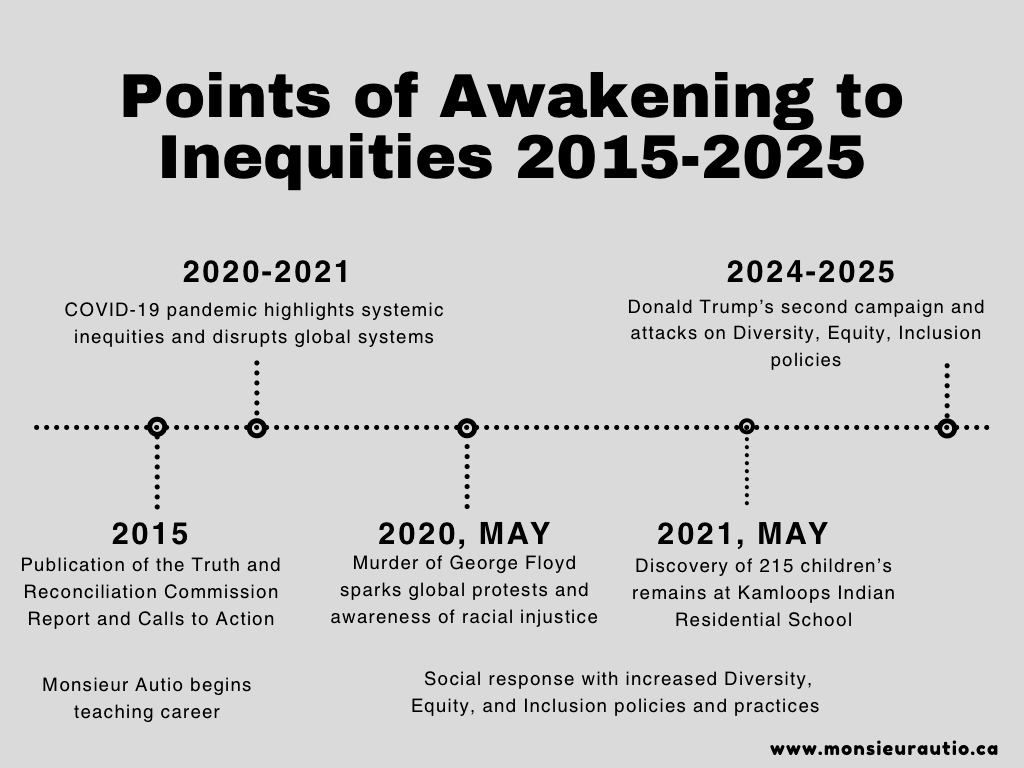
This year is my tenth year of teaching. During the past 10 years significant national and world events have occurred namely the publication of the report from the Truth and Reconciliation Commission in 2015 with it the Calls to Action, the murder of George Floyd in May 2020, the COVID 19 pandemic, the initial discovery of the 215 student remains at Kamloops Residential School in 2021, and Trump’s second term and his current war on DEI. These few events, among the many, all have in common a call to awakening to our dysfunctional society.
Tolle writes:
“The greatest achievement of humanity is not its works of art, science, or technology, but the recognition of its own dysfunction, its own madness…To recognize one’s own insanity, is of course, the arising of sanity, the beginning of healing and transcendence. A new dimension of consciousness had begun to emerge on the planet, a first tentative flowering” (2005, p. 13).
All of the aforementioned timeline points of awakening, as well as my own journey with mindfulness and consciousness, lead me to not just know about but better understand that our world has many inequities and a need for fairness and justice for all. Not only that, education has many inequities even within a single district, and even a school let alone a more macro view. As a teacher, the more we are aware of these inequities the more we can change (unlearn) and encourage change for and within our students and communities.
With awareness comes greater responsibility and urgency to act. Now that I know, what will I do now? One inequity that teachers were particularly awakened to during the pandemic when learning was thrust online was digital access inequity. What follows seeks to further understand the factors that contribute to the disparities in technology access.
Though perhaps seemingly small on the laundry list of inequities in our society, the ability to participate in the digital society by means of access, skills and use (meaning digital literacy), including social networking use, is a larger-scale social need than it may appear (Kwok & Korpela, 2024; Haight, Quan-Haase, & Corbett, 2014). Public libraries are having to take on increasing social services to support vulnerable and marginalized populations access technology (Gollum, 2024) and I witness public schools doing the same.
The causes of the digital access inequity are but a result of systemic inequities rooted in the systemic racism, classist/capitalist/colonial structures that have become prevalent in (J)DEI(A) conversations, though now “our values are being pressure tested” (Susannah Alleyne in CBC News, Are DEI Rollbacks Coming to Canada?) by the discourse in the United States.
Digital access inequities are caused by and reinforce:
- Socioeconomic and education level inequities (Scott, 2024; Kwok & Korpela, 2024; Kolomejac, 2023; Ben-David & Michalak, 2019; Scott, 2024; (Haight, Quan-Haase, & Corbett, 2014) Sciadas, 2002)
- Geographical inequities, access in rural and remote communities (Scott, 2024; Haight, Quan-Haase, & Corbett, 2014; Sciadas, 2002)
- Age, gender, and ability inequities including older adults aged 55+ (Haight, Quan-Haase, & Corbett, 2014) and marginalized youth particularly those facing mental health challenges, who experience racialization, who have LGBTQ2+ identities (Ben-David & Michalak, 2019)
- Immigration inequities (Haight, Quan-Haase, & Corbett, 2014)
The lack of inter-governmental coordination and strategy (Scott, 2024; Kwok & Korpela, 2024) and a narrow focus on infrastructure and not digital literacy (Kwok & Korpela, 2024) exacerbate the problem. There is also an assumption of universal access for “digital natives” though disparities of device quality and access to data plans exist (Ben-David & Michaelak , 2019) and that only broadband access is the key issue (Scott, 2024). Even more, the quality of technology needs to be up to date to meet the demands of the growing industry as Abdelaal & Andry (2022) report.
Consequences to digital access inequity could lead to furthering education disparities including digital literacy and widen skill gaps (Sciadas, 2002) to marginalized communities access to modern essential services like telehealth, banking, online education,overall reduced engagement in digital spaces and access to research (Kolomejac, 2023), and the opportunity to advance in e-commerce and remote work (Scott, 2024; Ben-David & Michalak, 2019; Collin et al, 2017; Rideout & Katz, 2016; Ribble, 2012; Wolohan, 2016). In sum, on Canada’s digital access “report card” we ranked 47th globally in our efforts to use information technologies to promote access and inclusion. This was a decline from previous standings (Kwok & Korpela, 2024).
But now that we’ve seen the problem, how are the solutions?
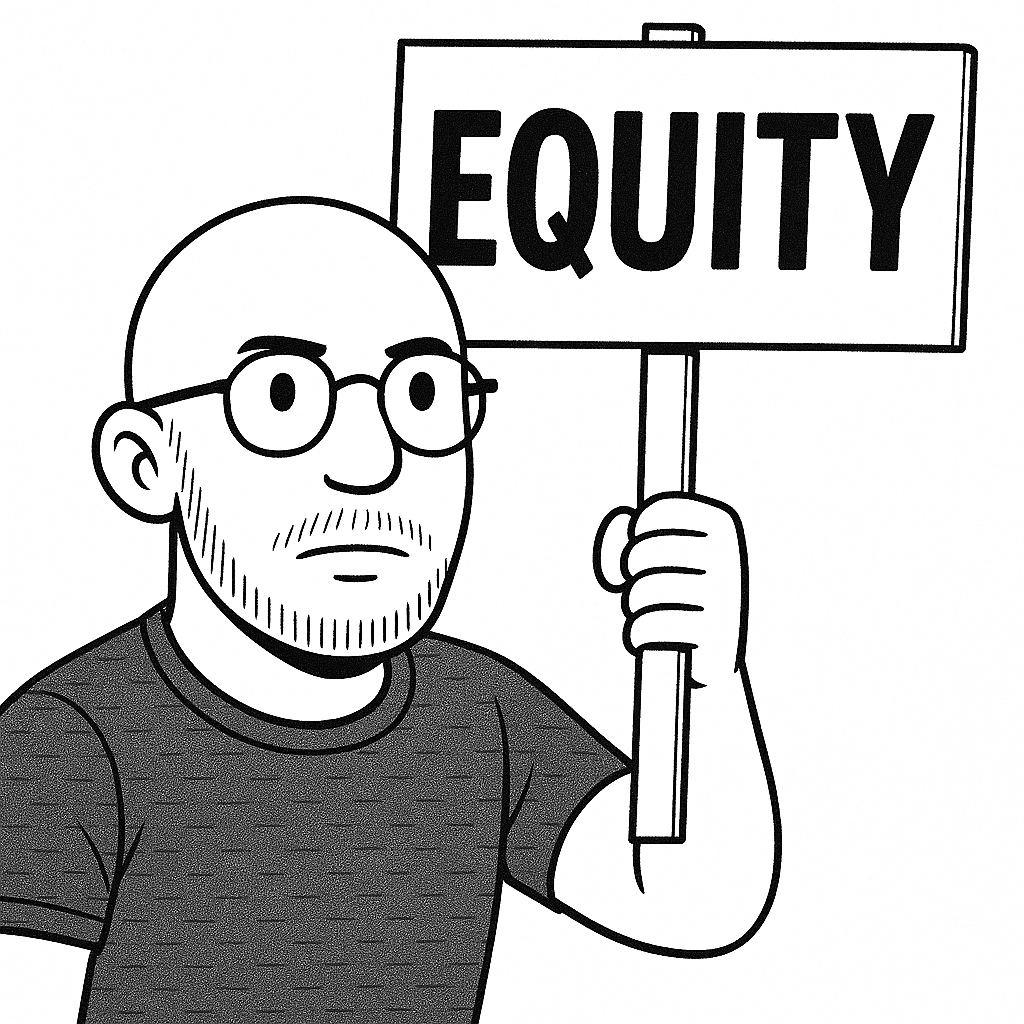
One primary solutions is improved macro level governmental strategies (Scott, 2024; Kwok & Korpela, 2024) that can target larger systemic inequities which hopefully includes publicly funded access to technology in all public schools. As it stands, we continue to live with ‘have’ and ‘have not’ public schools and districts and some ‘have more’ private schools which continue the extant dysfunctional divided society. In schools our role as educators must be to take on teaching digital literacy (Kwok & Korpela, 2024) for proper adoption and use what we have for more universal adoption and availability of technology (Scott, 2024).
TELL-3C Case 10 (n.d) offers some specific recommendations for teachers: one is to survey students to identify their access and provide devices or alternatives for students with access challenges. Providing access by making tech available for home lending via the school library or district with less barriers, similar to more and more public libraries (Gollom, 2024) and what we did more prevalently during the pandemic. This should be something we actively continue and perhaps commit to policy, if it’s not already in place.
As far an individual’s educator’s to do, our continued professional development towards awareness of digital inequity and how to promote better adoption of digital literacy with explicit teaching are paramount to working towards a true universal design for learning and overall fairness and justice for our students.
In sum, like the West German pottery, once you become aware of inequities you cannot unsee or un-know their existence and digital equity is but an extension of socioeconomic and other systemic inequities towards already marginalized people. With the awareness comes a time to research and begin collecting greater understanding, develop empathy, and devise and enact ways to take action and work fairness and justice for all including education, access, and advocacy.
Where do you see yourself in my story?
What is something you one day noticed and now cannot unsee?
What actions can you foresee enacting in your own practice?
What ideas seem to be missing from the solutions to bringing digital inequity to justice?
Autios! À la prochaine!
Bibliography
Amnesty International. (2021, May 25). Justice for George Floyd: A year of global activism for Black lives and against police violence. https://www.amnesty.org/en/latest/campaigns/2021/05/justice-for-george-floyd-a-year-of-global-activism-for-black-lives-and-against-police-violence/
Ben‑David, S., & Michalak, E. (2019, June 13). Bridging the digital divide among youth in BC. CREST.BD. Retrieved from https://www.crestbd.ca/2019/06/13/bridging-digital-divide-among-youth-bc/
CBC News. (2021, May 27). Remains of 215 children found buried at former B.C. residential school, First Nation says. https://www.cbc.ca/news/canada/british-columbia/tk-eml%C3%BAps-te-secw%C3%A9pemc-215-children-former-kamloops-indian-residential-school-1.6043778
CBC News. (2025, June 5). Are DEI rollbacks coming to Canada? (M. Galloway, Host) [Audio podcast episode]. In The Current. YouTube. https://youtu.be/EdyVuJ5uNgA?feature=share
Crown-Indigenous Relations and Northern Affairs Canada. (2015, December 15). Truth and Reconciliation Commission of Canada: Calls to action. Government of Canada. https://www.rcaanc-cirnac.gc.ca/eng/1524494530110/1557511412801
Gollom, M. (2024, March 5). How Canada’s libraries are bridging social service gaps. rabble.ca. https://rabble.ca/general/how-canadas-libraries-are-bridging-social-service-gaps/
Haight, M., Quan‑Haase, A., & Corbett, B. A. (2014). Revisiting the digital divide in Canada: The impact of demographic factors on access to the internet, level of online activity, and social networking site usage. Information, Communication & Society, 17(4), 503–519. https://doi.org/10.1080/1369118X.2014.891633
Kolomejac, S. (2023, October 25). Youth mentor’s perspectives: Engaging youth as researchers in the digital divide study. CREST.BD. https://www.crestbd.ca/2023/10/25/youth-mentors-perspectives/
Kwok, T., & Korpela, V. (2024, October). Canada is failing on the digital connectivity report card. What can we learn from leading nations? The Dais. https://dais.ca/commentary/canada-is-failing-on-digital-connectivity/
OpenAI. (2025). Monsieur Autio Advocates for Equity [AI-generated image]. ChatGPT. https://chat.openai.com/
OpenAI. (2025). Monsieur Autio Collects West German Pottery [AI-generated image]. ChatGPT. https://chat.openai.com/
Sciadas, G. (2002). The digital divide in Canada (Science, Innovation and Electronic Information Division, Catalogue No. 56F0009XIE). Statistics Canada. Retrieved from https://publications.gc.ca/Collection/Statcan/56F0009X56F0009XIE2002001.pdf
Scott, I. (2024). Conquering the next frontier in bridging the digital divide (IRPP Insight No. 54). Institute for Research on Public Policy. https://irpp.org/wp-content/uploads/2024/06/Conquering-the-Next-Frontier-in-Bridging-the-Digital-Divide.pdf
TELL-3C Case 10 (n.d.) The Digital Divide: Issues of Access. Critical Media Literacy and Ethics. University of British Columbia. https://blogs.ubc.ca/digitalmediaandethics/access/
Tolle, E. (2005). A new earth: Awakening to your life’s purpose [PDF]. Penguin Group. https://www.ikhtyar.org/wp-content/uploads/2014/06/eckhart-tolle-a-new-earth.pdf
Zhou, L. (2024, March 27). Trump’s war on diversity, equity and inclusion is dangerous for democracy. The Hill. https://thehill.com/opinion/white-house/5182718-trump-dei-attacks/


 Monsieur Autio
What do you think?