
Getting Through Math
My family loved playing Cribbage. I found every way possible to avoid the game because everyone seemed able to add in their heads while I was slow and could never keep up. I had to count the symbols one-by-one rather than group numbers together to make 15, and I’d miss points and sequences that everyone just seemed to know. When offered to play, I’d opt to watch as my family counted: “fifteen-two, fifteen-four and a pair is six,” but never understand the patterns for myself.
For me, math homework was always a slog. My dad must have lost his last few hairs explaining “moving the decimal over” or “adding zeros” for the millionth time when we talked about place value, yet it never made sense why the decimal moved left or right, or how to read large numbers with lots of zeros. Then came the infamous “mad minute” multiplication speed tests, where I memorized through trial and error rather than truly understanding multiplication as equal groups. Somehow I made it through school with decent marks, not because I understood the concepts, but because I figured out tricks to get through the tests. My marks often reflected competition and persistence more than genuine understanding. Even when math and music converged, I did not make the connection. Music theory was another example of “getting through” rather than understanding.
My saving grace was persistence and an incessant willingness to ask for help. I asked my parents, friends, and teachers to help me. I am grateful to my friends Sandra and Dominique for getting me through grade 12 math and first-year music theory, and to my parents, teachers, and professors for spending countless evenings, lunch hours, and office hours explaining the most basic concepts over and over, to little avail.
It was during my Kodály levels courses in my Masters of Music that music theory finally started to make sense. Breaking music down to its most basic elements to teach kindergarteners, I rebuilt my understanding through patterns. I asked comparative questions: is it the same or different? Higher or lower? Faster or slower? Louder or softer? It was from stripping music down to its simplest building blocks that I could start to see how Western music notation is structured, a realization that would later help me notice patterns in math as well.
Similarly, it wasn’t until my late twenties, when I finally had to teach kindergarten, that my math ‘lightbulb’ finally turned on. It wasn’t just about ‘getting through’ or trial and error anymore; suddenly, I could see the patterns.
Getting Through to Breakthrough
When I transitioned from teaching music full-time to teaching Kindergarten, I asked my friend Ms. VanDeventer for her key math resource. She pointed me to John Van De Walle, whose approach, like Kodály’s in music, emphasized moving from concrete to abstract. Fortuitously, our first professional development day that year focused on hands-on math activities led by Jen Barker.
That day, the switch flipped for me: math is patterns, and teaching math is about helping students see and describe them.
Kindergarteners needed to understand that numbers represent things, and I learned the key concepts of cardinality and subitizing (recognizing how one thing follows another and seeing small sets at a glance). The most revolutionary part of teaching kindergarten, for me, was understanding the importance of 10. I realized that digits are like the alphabet of numbers, while numbers themselves are like words that represent actual quantities, and that we live in a base-10 system.
I’m not sure if I simply wasn’t ready as a child or if learning in French Immersion kept me “dans la lune,” but suddenly, the idea of making 10 was crystal clear. Once I saw it, I could see its impact across all grades. When students at age five find all the combinations that make 10, the same concept applies to place value, rounding, and mental math. The mystery of numbers transforms into a puzzle of patterns, just like my family effortlessly did in Cribbage.
The ideas of anchor points and rounding became clear, too, and I finally understood why these concepts are foundational to everyday math. Since that day, math was no longer a mystery; it was a system of patterns waiting to be explored.
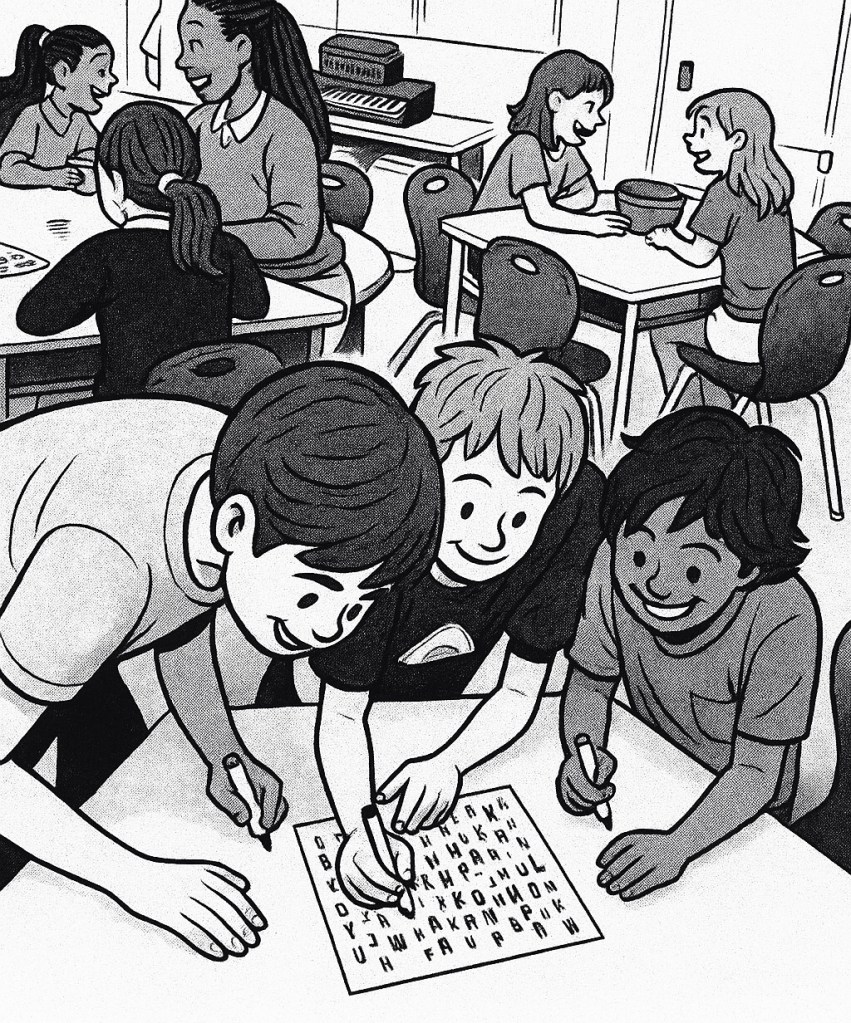
In my classroom today, these foundations are relaid each year. Activities like the “1-100” number routine not only reinforce the basics like cardinality but also help students collaborate and see that repeated practice and pattern-seeking and collaboration, not magical talent, are what make them stronger mathematicians. Through hands-on activities, games, and discussion, students begin to see that math isn’t just rules to memorize; it’s a system of patterns they can explore and describe together.
The Value of Patterns
After teaching grade 5/6 math for the past seven years, I have been experimenting with a patterns-based approach, focusing on unveiling the base-10 system to my students. Van De Walle introduced me to the guiding question, “Qu’est-ce qui vient ensuite?” (“What comes next?”), a deceptively simple idea that opens a world of understanding about number sequences and place value.
Teaching in another language adds a bonus: seeing how language informs thinking. For example, “ensuite” contains “suite,” one of many French words for “pattern.”
We use hands-on activities to make abstract ideas concrete. We start with a 1 cm square, add 9 to make 10, and then “ten becomes 1.” We continue with 9 more tens so that 100 becomes the new 1, then extend this pattern to 1,000. From there, a large strip of paper stretches down the hallway to represent 100,000, and eventually we take it outside to the blacktop to explore 1,000,000,000 using chalk (to save some paper!). This approach allows students to experience the scale and structure of the number system, rather than just memorizing rules and learning that by recognizing patterns we can predict the result.
When we bring it back to place value, students notice the repeating pattern of bloc (square) and bande (strip): 1, 10, 100, 1,000, 10,000, 100,000.
To reinforce these patterns visually, I’ve shared videos that show how numbers “roll over” into the next place value.
This skill naturally transfers to what many call “adding zeros” when multiplying or dividing by 10 or “annexing zeroes”; I call it “adding places” to reinforce that adding a zero doesn’t add value, it just shifts the number. Once students see the pattern, they can apply it across operations, building both confidence and number sense and perhaps saving a few dads’ hair along the way!
The excitement students show when we move from 1,000 to 10,000 in the hallway is contagious. Collaborating and problem-solving to create 1 million on the blacktop, and reacting to the videos as the numbers roll by, shows that they are not only engaged with math but also building a memory to draw on during worksheets and tests. It also serves as a review of the words we use for numbers and how, if we can name a number, we can often decompose it to its value.
Seeing Patterns Through Colour and Shapes
Another transformational tool for exploring patterns has been Prime Climb, not just as a fun game for mental math practice but for the vibrant use of colour. In conjunction with the guiding question “What comes next?”, this colourful chart has become a cornerstone of my math program:
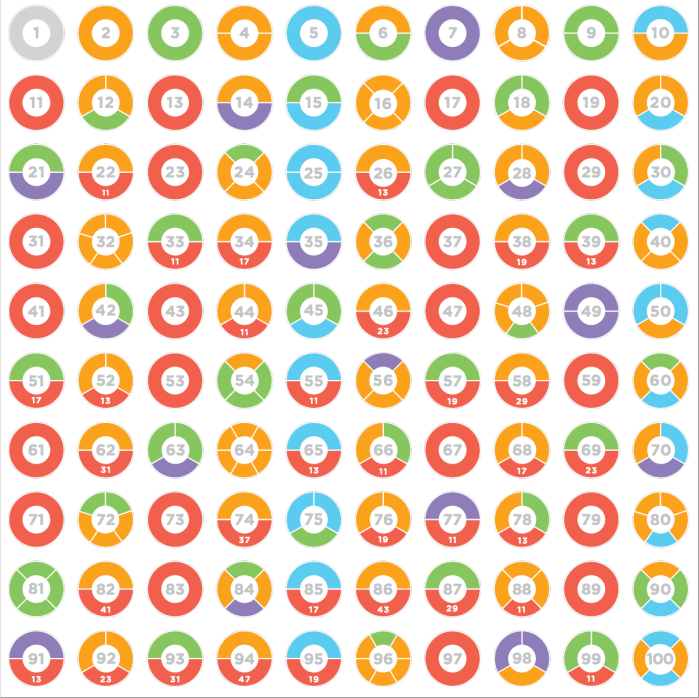
Even before we play the board game, we analyze a hundreds chart and ask, “What patterns do you notice?” Through this analysis, students begin to see patterns emerge:
- Orange highlights multiples of 2
- Green highlights multiples of 3
- Blue highlights multiples of 5
- Purple highlights multiples of 7
- Red marks prime numbers
As students notice these patterns, they also observe that some numbers carry multiple colours, revealing that they share multiple factors. For example, every even number has some orange with it.
To reinforce this understanding, I place large numbers 2, 3, 5, 7, and P on our math wall in their respective colours. Using Jo Boaler’s Dots activity, we transfer these colours to groups so students can see quantities represented visually. For students who are colourblind, we adapt by using shapes from the Dots set, ensuring every learner can access the same patterns.
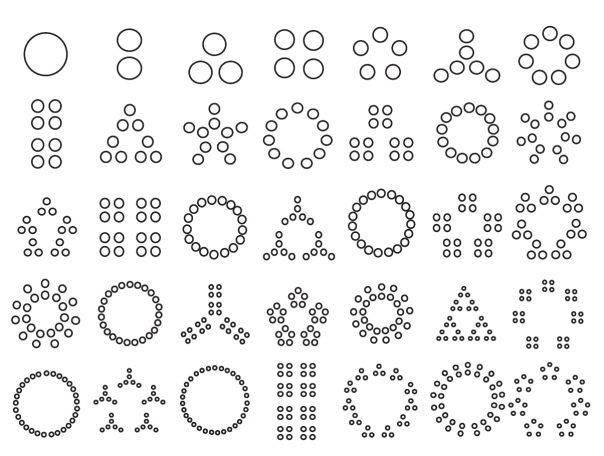
This year, students also created multiplication wheels from 1 to 12, colouring each number according to its multiples. When a number belongs to more than one multiple, students layer the colours on top of each other. These wheels become personalized mental math tools that students can use in tests, homework, or discussions.
The goal is for students to see patterns numerically, visually, and physically. As they colour, sort, and compare, students reflect, share, and often experience lightbulb moments: “Oh! 12 is orange and blue because it’s both a multiple of 2 and 3!” Even students with strong math backgrounds outside school are surprised at the insights gained from physically engaging with the patterns. This approach also supports differentiation while building a shared math vocabulary and code, strengthening our class community.
Through these multiple representations – charts, dots, wheels, and eventually fraction strips – students begin to understand the connections between numbers, factors, and multiples. The activity turns abstract ideas into concrete experiences, helping students internalize patterns they can draw on for future math learning, like multiplying and dividing multiple digits and fractions.
Applying Patterns to Operations
After exploring patterns with base-10 and colour, we move into multiplication and division of large numbers, using strategies that build directly on the concrete thinking students have already developed. For multiplication, we use area models and partial products to help students see how numbers are composed of smaller, manageable pieces. For division, we emphasize repeated subtraction and partial quotients, connecting the process back to the patterns of grouping and place value they’ve already experienced.
Recently, I attended the Building Thinking Classrooms workshop and was introduced to the vertical practice routine. In groups, students practice the strategies side by side, sharing and comparing their thinking. During student-led conferences, I invited them to show their parents how they approached problems with area models and partial quotients using the vertical surface.
One memorable example comes from a student demonstrating 24 × 36. At first, they showed the traditional two-digit multiplication method they had learned the year before. Then I asked them to present the area model, breaking the problem into (20 × 30) + (20 × 6) + (4 × 30) + (4 × 6), and to compare the two methods. The parent remarked, “This takes longer, but now I see why it works!” Parents confused by “new math” recognized that these strategies lay the groundwork for understanding traditional algorithms—something I (and perhaps they) only learned by memorizing steps without really understanding.
By grounding these operations in patterns and visuals, students see why traditional algorithms work rather than simply memorizing steps. For example, multiplying by 10 or 100 becomes an extension of the “ten becomes 1” hallway activity: numbers shift places rather than magically gaining zeros. This bridges mental math strategies, written algorithms, and concrete representations, giving students a unified view of mathematics.
We then extend these ideas to fractions and decimals. Fractions are introduced as equal parts of a whole, and decimals are framed as fractions in base-10. Students fold fraction strips, colour-code them according to multiples, and compare them visually, linking back to the pattern thinking developed with Prime Climb. During one activity, a student noticed, “1/2 of this strip is the same as 2/4!” Another student added, “Oh! So fractions are just like our multiples chart—some numbers share two colours, some share three, just like fractions can be equal in different ways.”
The folding of challenging denominators, like 7ths, 11ths, and 13ths, is always a highlight, and somehow they all manage! These challenges turn abstract ideas into tangible experiences, helping students internalize mathematical relationships.
Through this progression – from hands-on base-10 activities to colour-coded multiples, to multiplication, division, folding and comparing fractions to framing decimals as base-10 fractions – students internalize a conceptual understanding of mathematics rather than just a set of rules.
Patterns become their anchor points, helping them navigate increasingly complex problems with confidence, insight, and sometimes even joy.
And all roads lead me back to Kodály and music education. Breaking math down to its most basic elements helps everyone understand and build numeracy. Math comparative questions could be: are they the same or different? Are they equal or unequal? Equivalent or inequivalent? Is it larger or smaller? Did it increase or decrease? Is it odd or even? Will it come before or after? Does it fit the pattern or not?
Further exploration may reveal even more parallels between musicianship and mathematics!
Lessons Learned
Through all of this, I have come to believe a few key ideas about learning mathematics:
- Understanding is more important than memorization.
- Concrete experiences matter.
- Patterns unlock meaning.
- Struggling learners deserve conceptual entry points.
- Learning takes time, and it’s okay to not get it when you’re “supposed to.”
I used to think I wasn’t a math person, but now I see that I love math because I can see math as patterns. Now I can play too! A couple of months ago, I even initiated a game of Cribbage with my mom and dad and had a lot of fun! For the first time, I could understand why a 9 and a 6 make 15: by mentally regrouping my 6 into 5 + 1, making ten by adding the 9, and then adding the remaining 5. That small insight felt like a victory decades in the making.
The gift of learning late is that I get to share that joy with my students and my struggle. My hope is to help them have lightbulb moments far earlier than I did or at least encourage those who don’t get it right away that it’s okay; just keep asking questions and trying. For students who are mathematically gifted, I encourage them to share their thinking by developing questions and strategies that help others notice patterns for themselves.
I’ve seen firsthand the delight on students’ faces when they suddenly get it, and I feel better equipped to guide students to find their own understanding by helping them recall experiences we had together—whether it’s spotting patterns in multiples, folding fraction strips, or watching numbers “roll over” on our base-10 hallway strip. Those moments remind me why teaching math through patterns, concrete experiences, and multiple representations is so powerful.
Ultimately, my goal is for students to discover the fun, logic, and playfulness of math decades earlier than I did, and to leave them with the confidence that math isn’t about memorizing tricks; it’s about seeing patterns, making connections, and knowing they can understand.
Where do you see yourself in my story? Comment below.
What was your math story?
What are your anchor points in your math program?
What did my story remind you of or reinforce for you?

 Monsieur Autio
Leave a reply to LV Cancel reply