
Excellence Just Out of Reach
If school taught me anything, it’s that if you follow the instructions you will likely get a good result. If a teacher wanted you to use a specific format on specific type of paper for a particular date and you followed it as close as you could you were likely going to get an “A” if not a very high “B”. Once I figured this out, school became nothing more than a strategic game. In many ways, intelligence, talent, and creativity had very little to do with achieving good results; if you can check-off the criteria, you could generally manipulate the outcome in your favor.
As I grew up getting high marks and being a high achieving “keener” became my identity. I would get incredibly upset if I got low marks and spent most of my high school and university days jealous of the kids, typically girls, who had higher marks than me, who took harder courses than me, who were in higher Royal Conservatory piano levels and marks, and who were in any other sort of advanced group or club. I increasingly lived in a state of comparison and competition with my classmates, rarely enjoying what I was doing. More often than not, I didn’t fully understand what I was doing — particularly in math — even though my results often said otherwise.
The competition for academic excellence started as early as Grade 1, 6 years old, when some kids got to go to Apex, the “advanced” group of mostly girls, where they got to do something special because they were either smarter or more “gifted” than the rest of the class. The comparison and striving was solidified in Grade 4, 9 years old, when we first got letter grades on our report cards; henceforth, contests and competitions became the norm.
French Immersion in the 1990s and 2000s was a breeding ground for a competitive culture starting with class economies and prizes for speaking in French to being allowed to use cursive writing to assignments in Grade 3. These seemingly innocuous competitions and comparisons evolved into concours d’art oratoire (an annual French speech competition) from grades 4-12, science fairs with ribbons in the gym, taking “honours” English classes, and ultimately high stakes provincial tests scores and Grade 12 achievement awards. Between me and the girls and some other French Immersion band nerds, I consistently sought out superior status through high grades and achievements. Through following the criteria for all these competitions as best I could I would often get in the proverbial arena I only rarely got the top recognition or results.
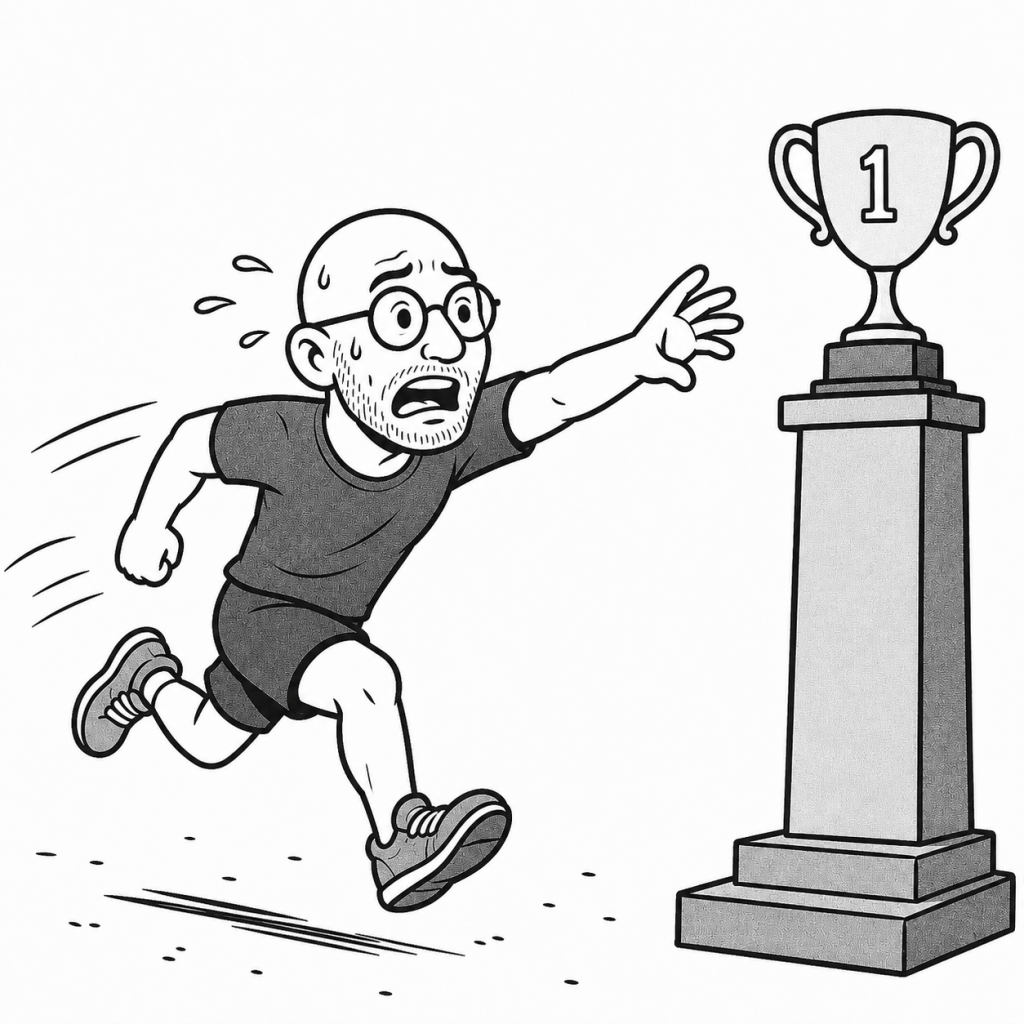
Interestingly enough, my parents did not put the same pressure on me that I put on myself. They always just said “all we expect is that you do your best” and yet my best never seemed good enough for me. I would say my peers and the social landscape were the impetus for competition including 1990s and 2000s pop culture reflecting the general social norms of “having to” get high SAT scores(though not a Canadian reality) and get into university to be successful.
This setting was likely a major factor for my striving for achievement; however, looking back, my “keener” identity was even more likely a strategic attempt to try to deflect others from seeing that I was gay. I was trying to control my own narrative rather than being called out for being an outsider in my religiously conservative town. For many of these formative years I was ashamed of myself and attempted to “pray the gay away” and manipulate how I was perceived. It didn’t work, everyone knew and I was only keeping myself from fully experiencing life!
For such a competitive person, I did not get into team sports. My brief foray with hockey at age 6 confirmed that being surrounded by competitive boys was not a comfortable or fun place for me. Around age 12 my parents said, “you need to choose some sort of sport” as I was growing not only in height but also in weight. They offered to pay for any sport but I had to choose something. I had always enjoyed swimming as a child spending hours in lakes and pools during summers and I had done swimming lessons here and there so I eventually chose to enroll into swimming lessons. I was hooked!
I started back in around Red Cross AquaQuest level 6 or 7 and made my way through all my levels. My favorite instructor was named Joe Mante. He was a fantastic teacher who encouraged me to eventually do all my life guarding and even taught my lifeguard courses. I ended up becoming a regular volunteer at the pool spending many hours there learning from lifeguards and practicing my strokes and lifesaving skills. Once I could I took every course requirement to become a lifeguard and worked hard to be the best lifeguard I could be.
Throughout my time as a lifeguard I would often longingly look into the weight room and wanted nothing but to look like the muscular guys I saw there, in magazines and on TV— but I was too scared to be found out for my “shameful” sexuality that I never had the courage to start training and start bodybuilding. But, I swam and aimed to live a balanced and healthy life – “everything in moderation” as my mother would say.
Around the same time, in high school I joined the recreational swim team whose coach, Mr. Smith, truly made the swim team a “come-one-come-all” environment regardless of ability. His competitive strategy was to go into provincial competitions with the highest number of participating swimmers, regardless of level, and our team often won provincials as a result of our sheer numbers rather than having a small number of high calibre swimmers. He was all about making PRs (Personal Records) and did a great job at celebrating each member of the team and making them feel welcome. There were ribbons and awards galore at our season end dinner and the competitions were a fun place to be (and get out of classes!). On the school team were also swimmers who were on competitive swim teams outside of school. I soon found out that my times and results were far from what the kids who were swimming competitively since they were essentially toddlers though they were respectable for someone who only really started a few years before. This surely fed into my omnipresent feelings of inferiority. As with my academics I was good but I was far from great. I was never excellent in any realm, I was always behind and wished to be someone I wasn’t. My mother would often say “don’t wish your life away” though neither of us knowing that I was there never wanted to be who I truly was.
The feelings of inferiority slowly became an inferiority complex (a retroactive self-diagnosis). Not only did I feel shame for my sexuality, but for everything I did achieve, I felt like I was still behind and never excellent or great. Regardless what I accomplished, it was always due to luck and circumstance — which isn’t altogether false in the sense of Malcolm Gladwell’s Outliers (2008) and my positionality in the world— but I never considered that I still had a role to play in my successes.
If French Immersion was the breeding ground of my feelings-of-inferiority-driven competition mindset, music school in university became the ecosystem in which my inferiority complex and imposter syndrome flourished. I never felt worthy of being in music school. I felt I was accepted only due to the rarity of my instrument and constantly felt behind the other students in all areas. So many had either gone to arts schools or took lessons from prestigious teachers since they were very young, and/or where lead players in different bands and orchestras. Performance majors were “the elite” and though I knew I wanted to be a band teacher I wanted to be as good as them. Egos were strong throughout the school and my ego was scared to bits.
Fear and hiding aside, I certainly made friends and had many excellent experiences. I loved my adventures in growing up — buying groceries, keeping my apartment clean, continuing to lifeguard and be a resident advisor all while practicing my euphonium 3 hours a day (because that’s what my high school tuba-euphonium teacher, Sean said you do when in music school!), meeting new friends, going on exchange to England, and figuring out life on my own— and really accomplished a lot that I should have been proud of.
Being across the country and later the world from my family was a big part of the experience, yet my parents were always a phone call away. Almost every Thursday after Wind Ensemble my parents would have to talk me down from my anxiety and fear of not being good enough. They’d be a sympathetic ear and often tell me to call back after I eat something, which usually did the trick, and continue to remind me to just do my best.
On one of my first days at University of Ottawa I remember finding the classroom for my music theory placement exam and approached a small group of Francophones who would become my main cohort for several of my core courses. During this very first awkward meeting of strangers I tested out my French Immersion skills and introduced myself saying I was from a town near Vancouver, BC. Right away Véronique excitedly shared that she was born Vancouver, soon after she invited me over to her house for dinner. Her friendly connection soon led me to being quasi-adopted by her incredibly generous family who let me struggle with my French, took me to Costco, allowed me to do my laundry in a decent machine, and even invited me to joined a family trip to Mont Tremblant!
One day I was talking with Véro’s mom, José, about life. It must have been something related to confidence or self-esteem but honestly I can’t remember. She said something that has always stuck with me, though, “One day I started to believe the good things people said about me.” It’s taken me many years to understand what she meant. Rather than dismissing praise and recognition — and even my own accomplishments — I can start to see that there are good qualities about myself rather than only deficits.
My deficit mindset towards myself continued through my undergraduate and even into my graduate work at University of Victoria. During my transition from UOttawa to UVic I took private lessons with Gene Dowling while working part time at a music store and taking some courses part time. It was during this year that Gene recommended I apply for my Masters in Music Performance while finishing my pre-requisites for my Bachelor for Education. I took the opportunity and did my best to fulfill the criteria. I worked as hard as I could. Though I continued to excel at many things and received praise and experience, I still never believed I really earned my performance degree, deserved to be there, or ever achieved excellence. I was still competing with my classmates for high grades, achievements, and even who was more “type A”! Though there were fun times and many great experiences, I look back and feel like I was not truly present or fully aware of the love and relationships I had.
While at UVic I became enamored with Kodály and his ideals for music education. One of which that speaks to me is “Let us take our children seriously! Everything else follows from this…only the best is good enough for a child” (Kodály, 1940 in Bonís, 1974, p. 140) which my ego-centered self took as “I must be the best musician (and therefore performer) to be the best teacher.” The elitist part of me was affirmed and my yearning for superiority continued. I worked diligently and relentlessly. I have shared before when I asked Gene, “What makes a great teacher?” to which he replied, “You should know, a great teacher is one who inspires.” His words really struck me as they were not what my ego had anticipated, or perhaps wanted, to hear. They were, however, what I needed to hear.
During the UVic chapter of my life I had finally come out to friends and family and started dating. This coincided with the popular “It Gets Better” project (NOH8, 2010) though I can’t say that it was the impetus for my coming out — I think I just decided it was time to stop lying to myself — and life truly did start to get better after I did come out. Looking back, paradoxically, finding a partner was a pivotal part of my journey towards self-actualization. As I was dating I had to become more confident with who I was and literally put myself out there in the world.
I successfully graduated my Masters of Music and Bachelor of Music and had an emotional teaching practicum (a story for another day) and eventually I found Mr. Tong. Our journey together started the same year as my career and thus my personal and professional growth are intertwined. Through the sudden loss of our dog to a car accident the year of our marriage, we co-discovered the ideas of presence and consciousness bringing me to a new stage in my life.
The benchmark of excellence was, and in many ways still is a part of me. What I have come to learn from my many conversations with Mr. Tong and my oft-quoted Oprah Supersoul Conversations Podcast, Tolle (2005), and later Katz & Lamoureux (2018), Palmer (1998), Kishimi & Koga (2019), I developed cognitive dissonance with my striving for excellence that, in recent years, is resolving towards harmony. I have had to reframe my sense of self and how I engage with competition. This will be explored in Part 2.
Through my own experiences and reflections I have begun to share my learning with my students and colleagues through how I interact and build relationships with them, design experiences for them and assess and evaluate them. Even through sharing my story in this blog, I hope to inspire educators to look within themselves to see their own gifts and transformations. My hope is that others can learn something from my journey’s ordeal and transformation that they can take into their lives.
Where do you see yourself in my story? Leave a comment.
Do you consider yourself a competitive person?
How do you navigate feelings of inferiority or imposter syndrome?
References
Gladwell, M. (2008). Outliers: The story of success. Little, Brown and Company.
Katz, J. & Lamoureux, K. (2018). Ensouling our schools: A universally designed framework for mental health, well-being, and reconciliation. Portage & Main. Winnipeg, MB.
Kishimi, I. & Kona, F. (2019). The courage to be disliked: the Japanese phenomenon that shows you how to change your life and achieve real happiness. Translated by Kirawareru Yuri. Simon & Schuster Canada, Toronto, ON.
Kodály, Z. (1974). Selected writings of Zoltán Kodály (Bónis, Ed.). Boosey & Hawkes.
NOH8 Campaign. (2010, November 11). NOH8 releases “It Gets Better” & “Anti-Bullying” videos. NOH8 Campaign. https://www.noh8campaign.com/article/itgetsbetter
OpenAI. (2026). Monsieur Autio reaching for trophy image. [AI-generated content]. ChatGPT. https://chat.openai.com/
Palmer, P. (1998). The courage to teach: exploring the inner landscape of a teacher’s life. Ed. 1. Jossey-Bass. San Francisco, CA.
Tolle, E. (2005). A new earth: Awakening to your life’s purpose [PDF]. Penguin Group. https://www.ikhtyar.org/wp-content/uploads/2014/06/eckhart-tolle-a-new-earth.pdf
 Monsieur Autio
What do you think?