
Excelling at Mediocrity
My dad is an avid reader. Throughout my early school years, I remember waking up and going downstairs to find him at the kitchen table, one hand holding a spoon for his porridge and the other holding open a book or scanning the newspaper. I’ll always remember one particular day when we were clearing off the table for dinner and I saw a brand-new Apple laptop casually thrown on the table.
“Whose is this?” I asked.
“Oh, that old thing?” he replied.
The scene of my dad reading has shifted now that he is retired to being cross-legged on the couch with a coffee in one hand as he continues his goal of reaching the end of the Internet.
My dad was not a great school student by any definition. He proudly shares how he would frequently skip class and take tests until he knew he had passed, then leave. But by all means, he is an extremely good student of life: intelligent, curious, aware, and well-read. He is interested in many things, from computers, fountain pens, woodworking, and cooking to, lately, learning Spanish, to name only a few. I often remember him saying that he “excels at mediocrity,” and as I mature, I can proudly say that I have inherited his mediocre genes.
I say this in jest and in humility, as much as my dad does. In fact, when I stepped off stage at my second bodybuilding competition this past May, having placed 8th of 13 competitors, the first thing I said to my parents was, “Well, once again our family excels at mediocrity.”
Unlike my first competition in 2023, however, I said it and actually meant it.
I have shared my bodybuilding journey toward self-actualization before, but I did not fully share how humbling and upsetting that first competition actually was. I had strictly and relentlessly adhered to my diet, training, and preparation. I had learned how to pose for the first time, made great connections within the bodybuilding community at my gym, developed relationships with my coach and wellness team, and was in the best physical shape of my life. Friends and family traveled with me to support me, and many people encouraged me by saying, “You’ll do well!”
I thought I would.
Backstage, other competitors were saying things like, “We’re already all winners just by getting here.” I mentally scoffed at the idea, though I knew enough to smile and nod politely. I had my head in the right place—or at least I thought I did. I believed that if I followed the instructions to the letter, worked hard enough, and prepared properly, I would achieve the desired result: a top placing, just like so many of the guys I followed on Instagram and saw at the gym.
Instead, I placed 7th of 8 competitors in my class.
I held back tears until I got back to my hotel room. I felt like I had let down my family, my friends, and my coach. More than that, I felt like a complete failure. My intense feelings of inferiority flared into a flame, and the experience shattered my belief that hard work was supposed to guarantee a favourable outcome.
Looking back, I can see that I was still caught in many of the egoic thinking patterns I had been trying to move beyond. I had spent years practicing the mantra, “Let me be patient, let me be kind, let me be generous, let me be humble,” while still struggling to actually embody those states of being. I had also been reading Eckhart Tolle and learning about presence, yet I was still, in many ways, wishing my life away—waiting for the next achievement, the next version of myself, the next moment when I would finally be “enough.”
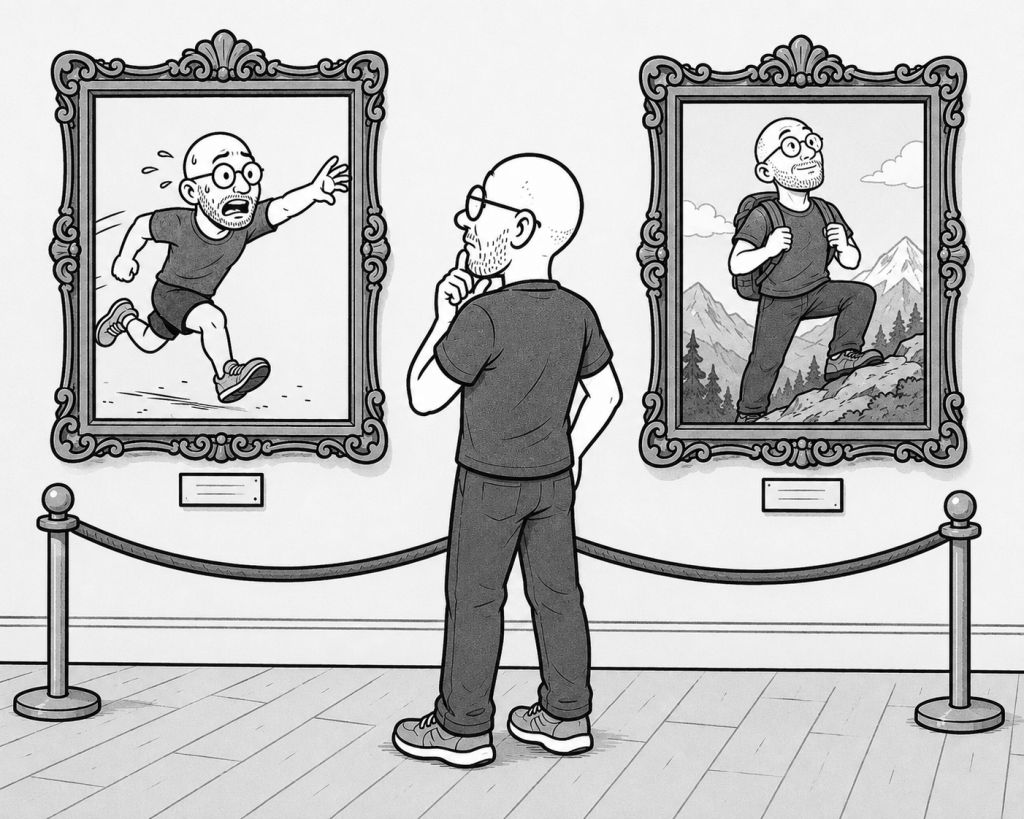
M. Autio Viewing Competition (Image by Open AI)
The three years between my first and second competitions became a process of rebuilding not only my body, but also my mind and spirit. There were several small “aha” moments along the way. I remember lying on my aunt’s hide-a-bed on a hot summer night, just before falling asleep, and suddenly realizing, I am truly loved by my family and friends. Another came as I was about to lift the bar off the decline bench press: This is supposed to be fun! And another came while rewatching Disney’s Hercules during cardio, when I realized I was on the hero’s journey — a journey that inevitably includes an ordeal or crisis before transformation.
During this process, I developed stronger relationships with my coach, Matt, and my friend Alex. I continued seeking feedback and treatments from my wellness team, Edmond, Ethan, and Yuki, and became increasingly connected to other bodybuilders. I also encountered two books that became important “mentor texts” for me: Ichiro Kishimi and Fumitake Koga’s Courage to Be Happy (2019) and Parker Palmer’s The Courage to Teach (1997). Both books helped me contextualize and rationalize ideas I had been wrestling with for years, particularly around courage, belonging, comparison, and the relationship between the self and the community.
Kishimi and Koga’s books introduce key ideas from Adlerian psychology. They explain that all humans experience “feelings of inferiority” and seek belonging within a community. The means through which we develop this “community feeling” is through cooperation and the courage to be ourselves — developing self-reliance and independence while also seeing others as comrades and equals.
This became particularly challenging when I decided to enter another men’s physique bodybuilding competition. From an Adlerian perspective, competition can become a “disease of the community” when another person becomes a rival we need to defeat. Kishimi and Koga (2019) explain that when the goal shifts from completing the race or doing our best to defeating another person, competition can create feelings of envy and inferiority and even lead to unfair conduct (p. 122).
This challenged me. How could I reconcile what I was learning from the Kishimi-Koga/Adler perspective with my desire to compete again?
The answer ultimately came down to how I framed my why for competing—what coach Matt would call my “champion mindset.” I wanted to compete to show myself that I could be unbothered by the result.
For me, “feelings of inferiority” were often internalized. I was, in many ways, my own rival. Rather than seeing my competitors as people I needed to defeat, I felt that I was disappointing the people who had supported me if I did not win and that those who beat me were better than me. I felt that my values of discipline, hard work, and commitment had somehow not been rewarded because I did not receive the placing I wanted and that losing was a personal value judgement. I was accustomed to seeing hard work produce a favourable result, so it was difficult to reconcile the reality that I could give something my absolute best and still not receive the outcome I wanted.
This time, I knew I needed to prepare mentally for every possible result. How could I participate fully, work toward improvement, and remain connected to the community even if the final result did not reflect the effort I had put in?
One idea that helped in Courage to Be Happy, Kishimi and Koga (2019) emphasize Adler’s idea of horizontal relationships, where people are equals rather than competitors. As the Philosopher explains, “one does not compete with anyone, and there is no winning or losing” because differences in knowledge, experience, or ability do not change our fundamental equality (p. 125). This challenged some of my assumptions about competition while also affirming what I was beginning to experience: the people I compete against do not need to be my enemies. They can be the people who push me to participate more fully, improve, and experience the game (the fun!) alongside them.
Adlerian psychology also changed how I understood feelings of inferiority. These feelings are not necessarily negative; they can reflect our desire to improve and find a meaningful place within a community. At one point in my training, I realized that my negative self-talk and constant comparisons could be reframed. Instead of I’m not good enough, I could think, I’m ready for the next level and when comparing my physique to others reminding myself that we’re playing the same game.
I developed mantras like, “I’m still far from where I want to be, but closer than I’ve ever been,” and reminded myself of the Adlerian idea that “we’re equal but not the same; we’re on the same path moving forward.”
In The Courage to be Happy, the Philosopher explains that our most fundamental need is a “sense of belonging” and the feeling that “it’s okay to be here” (Kishimi & Koga, 2019, pp. 135–136). I found this particularly meaningful in thinking about bodybuilding. Competition can certainly be a way of distinguishing ourselves from others, but it can also bring together people with shared interests, goals, and experiences.
Interestingly, the prefix com, meaning “together” or “with,” appears in words such as compare, compete, and community. This connection helped me rethink what it means to compete. Compare is to make equal; compete comes from the idea of striving together. Rather than competition being about one person becoming superior to another, I began to see the “game” itself as the third thing—the thing none of us will ever completely master. What do we each bring to the game? What do we contribute to the community? How can we make one another better simply by participating?
My competitors, then, are not people I need to be better than. They are a community of equals who help make the game worth playing.
This also connects to Kishimi and Koga’s idea of having the “courage to be normal” or the “courage to be myself” (2019, p. 135). The Philosopher argues that our worth does not come from being outstanding or different from everyone else, but from being ourselves. This counters so much of what we are encouraged to believe in a capitalist society, where standing out, achieving more, and becoming exceptional are often treated as measures of self-worth.
Yet the idea echoes truths I have encountered throughout my life: “comparison is the thief of joy,” attributed to Theodore Roosevelt, Gerry King’s reminder that “we are independent musicians working interdependently,” the ideals of LGBTQ+ Pride, and, of course, my dad’s wisdom of “excelling at mediocrity.”
The courage to be normal is allowing me to further excel at mediocrity. I can now reframe my habit of comparing myself to others at the gym, and professionally and personally, into opportunities to encourage others and recognize their contribution. Instead of thinking, I’m not where I should be, I can return to my mantra: “I’m far from where I want to be, but closer than I’ve ever been.” There is something liberating about releasing the pressure to be exceptional. It allows me to enjoy the process more and appreciate where I am while still working toward where I want to go.
My second competition was therefore a very different experience. I placed 8th of 13 competitors. I was still, objectively speaking, “good but not great,” yet I left the competition feeling content and satisfied. Most importantly, I felt unbothered by the result.
I actually laugh at myself when I think about it. While we were on stage, I was standing on the “second-place” box and was so excited leaving the stage. It was only backstage, when they lined us up, that I realized I was nowhere near the top five. Unlike my first competition, I was not angry, sad, or upset. I simply laughed at myself for being so excited on stage in front of everyone. Yet, the excitement translated to my other personal goal of shining while on stage.
When I received my participation medal and was unceremoniously allowed to leave, I was completely unbothered by my own misunderstanding. I was still highly satisfied with the experience. There was no holding back tears or fear that I had disappointed my family and friends. Instead, I felt gratitude for the people who had come to watch me and excitement for the next competition the following week, where I would see some of the new friends I had made that weekend. That competition was a lot smaller and I even got some hardware, though the classes were much smaller sometimes me being only one of two or three people on stage.
What had changed was not the result, but what I was paying attention to. In 2023, the placing almost suprisingly consumed me even though I didn’t initially want it to; this time, the people, the experience, and what came next truly and authentically mattered more.
That does not mean I no longer want to improve; I simply know that I can take the information from the judges and the experience itself and make choices about how to move forward. I still want to build a better physique, become stronger, and see how far I can take this hobby. The difference is that I am learning to separate improvement from worthiness and to treat results as information rather than personal judgment.
This has also changed how I understand excellence. Excellence does not have to mean superiority or being exceptional. I can work toward excellence without expecting exceptionalism—the idea that I must be above or better than others. I increasingly think of excellence as acceleration—forward movement. It is what my vice principal, Mlle. Lee, describes as “relentless incrementalism, what coach Matt’s encouragement to become the best version of myself, and Adler would offer as moving forward with courage.
Kishimi and Koga’s Philosopher says,
The person who is capable of feeling truly happy only upon being praised will seek to get praised more until the very last moment of their life. Such a person, having been left in a position of dependence, will lead a life of ceaseless seeking, a life without fulfillment… Instead of seeking approval, one has to approve oneself, with one’s own mind….It’s okay to be just as we are. Your place to be is there, without needing to be a special being or be outstanding in any way. Let’s accept our ordinary selves, ourselves as “everyone else”…. Instead of placing worth on “being different from other people,” place worth on “being yourself.” That is true individuality. A way of living in which, instead of being yourself, you compare yourself to others and try to accentuate only your difference, is just a way in which you deceive both others and yourself.” (pp. 136–138)
The idea of the courage to be myself (p. 135), or more aptly, the courage to be normal, counters so much of our capitalist society’s norms, yet it is also a profound truth that has been espoused throughout my life. We are all unique individuals. It echoes the idea that “comparison is the thief of joy,” attributed to Theodore Roosevelt, as well as so many ideas from teachers in my life, including Gerry King’s “we are independent musicians working interdependently,” the ideals of LGBTQ+ Pride, and my dad’s wisdom of excelling at mediocrity.
We are equal, but not the same.
Competition Reframed
My new definition of competition is simple: competing does not mean being better than another person; it means participating, improving, and connecting with others through the game. Sometimes you win and sometimes you lose. That is part of playing any game. And let’s remember: games are supposed to be fun!
The real lessons of competition are found in having the courage to show up, contribute, encourage others, and catch glimpses of the person you are working toward becoming. My “mid” success is therefore not defined by a placing or result, but by how much closer I am than I was before.
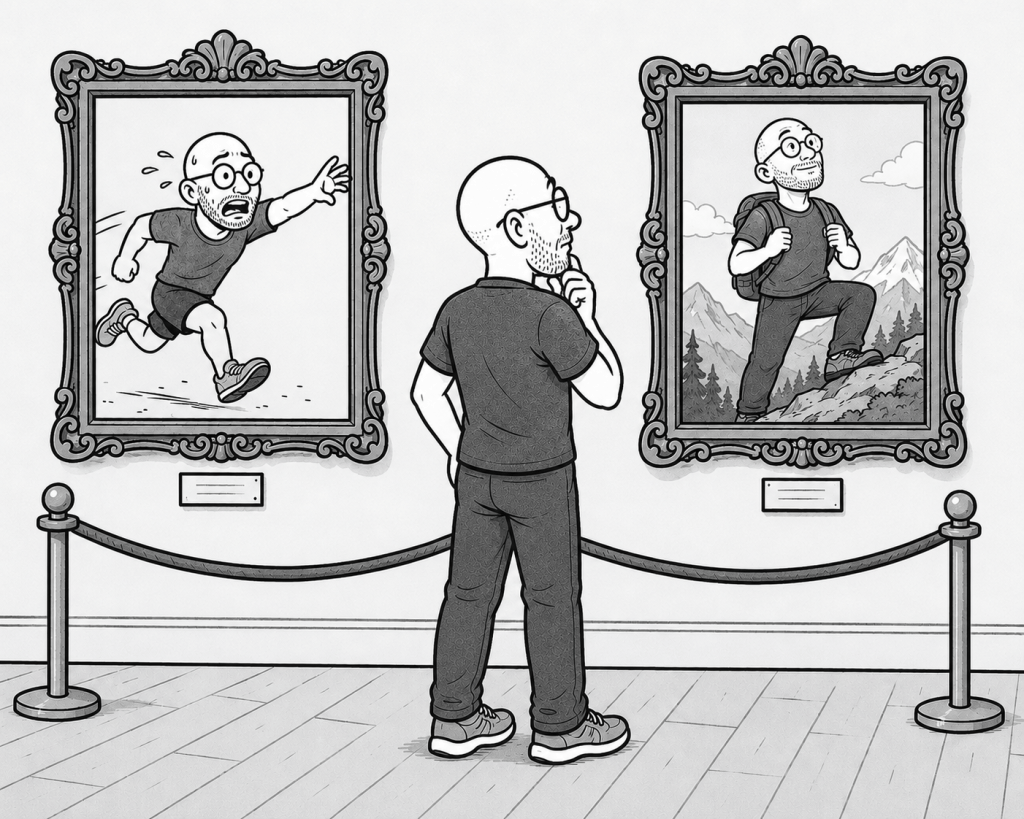
Monsieur Autio Reframing Competition (AI-Generated Image)
This is what a champion mindset means to me now: not necessarily winning the game, but playing the game with my whole self and encouraging my comrades to do the same.
Through all of this, I have learned the courage to be mediocre. I have learned that I am still part of a loving community regardless of the results of my efforts. I have also learned that putting myself in situations where I must become more self-reliant and self-actualize gives me experiences I can share with my students. I cannot simply teach them about courage, belonging, failure, or growth; I have to practice those things myself.
From Learning to Teaching
Some of the meaning I am taking from my competition experience this year is that competition is not inherently “bad”; it needs to be framed as an opportunity for building self-reliance and community rather than as a measure of personal judgment or value. This has made me think differently about how I design learning experiences and assessments and how I foster a democratic classroom. Kishimi and Koga’s discussion of vertical and horizontal relationships challenges me to reconsider the ways I use praise, rebuke, rewards, and punishment with students. Treating students as equals through mutual respect and acceptance is fundamentally opposed to many of our social norms, including how we assess students, rank them, and promote competition.
Many ideas of Adlerian psychology ring true to my heart. They are simple, but by no means easy, to put into practice. This year I plan to have my copy of The Courage to Be Happy on my desk ready to help me reframe situations and respond to behaviours with greater respect and community feeling.
To achieve this, I believe one first step is to fully accept myself as the normal, mediocre bodybuilder, teacher, and human that I am. From there, I can reflect on Adler’s concept of the “separation of tasks”: What is my task as the teacher, and what belongs to the students? Rather than trying to control students’ responses, outcomes, or approval, my task becomes to create conditions where students can make choices, develop self-reliance, and feel that they belong.
This brings me back to my mentor Gene’s quote, “A great teacher is one who inspires,” and Parker Palmer’s idea that a mentor evokes within us the values and gifts we already possess. We inspire by being in tune with ourselves and, in turn, encouraging our students to build self-reliance, self-actualize, and improve. By fostering environments where students can experience feelings of inferiority without being defined by them, where they can strive without needing to be superior, and where they understand that someone else’s success does not diminish their own, we can work toward a better society.
In my classroom this year this means shifting my own focus towards encouraging without creating dependence on my approval and challenging students without making them feel that their worth is tied to their performance. The goal of competing and playing games becomes contribution to community over superiority.
In sum, maybe there is nothing wrong with excelling at mediocrity. Maybe the goal was never to become the best person in the room. Maybe the goal is simply to keep becoming a better version of yourself while helping the people around you do the same.
Where do you see yourself in my story? Comment below!
How have you lived a hero’s journey of transformation?
What do you think of Adler’s challenge to renounce punishment and praise?
Have you come to terms with your own mediocrity?
References
Kishimi, I. & Koga, F. (2019). The courage to be happy: the Japanese phenomenon that shows you that true contentment is within your power. Translated by Kirawareru Yuri. Simon & Schuster Canada, Toronto, ON.
OpenAI. (2026). Reframing Competition 1 and 2. [AI-generated content]. ChatGPT. https://chat.openai.com/
Palmer, P. (1998). The courage to teach: exploring the inner landscape of a teacher’s life. Ed. 1. Jossey-bass. San Francisco, CA.

 Monsieur Autio
What do you think?